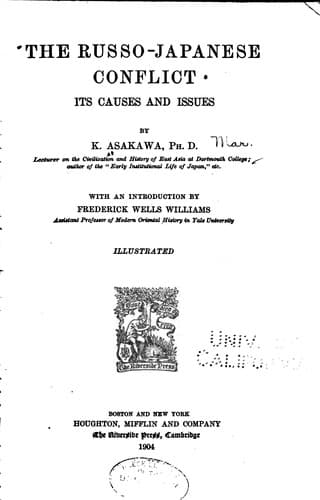
The Russo-Japanese Conflict: Its Causes and IssuesAsakawa, Kan'ichi
History
The Russo-Japanese Conflict: Its Causes and Issues
Asakawa, Kan'ichi
Russo-Japanese War, 1904-1905; Russo-Japanese War, 1904-1905 -- Causes
Coming still nearer to the practical side of the Protocol, it is not
difficult to see that, of the three methods already explained, one
stands out as the most important and most difficult,—the reform. No
greater burden and no more delicate work for a nation can be imagined
than that of regenerating another whose nobility has grown powerful
under corruption, and whose lower classes do not desire a higher
existence. On the other hand, the inertia and resistance of Korea would
be tremendous, in which her “full confidence” would give place to hatred
and rancor. The proverbial machinations of the peninsular politicians
would be set in motion in all their speed and confusion. It would not be
surprising if, under the circumstances, even a military control of Korea
of a temporary and mild nature should become necessary in order to cure
her malady and set her house in order. On the other hand, when the
necessary reform should be so deep and wide as is required in the
present instance, the temptation of the reformer would be great, and the
suspicion of the reformed even greater, where political reformatory
enterprises border upon the economic.[687] Here and everywhere, Japan
would save herself from the gravest of errors, in spite of her best
intention in the large issue, only by the severest self-control and
consummate tact. Great is the penalty of Japan that arises from her
peculiar position. She has never encountered in her long history a
greater trial of her moral force as a nation than in the new situation
opened by the Protocol. As to the world at large, it will look forward
to an intensely interesting experiment of human history.
-----
Footnote 680:
The _Kwampō_, February 19 (1904), p. 387.
Footnote 681:
Ex-Secretary of War Elihu Root’s speech at the Republican Convention
at Chicago, June 21, 1904.
Footnote 682:
The _Kwampō_, February 19 (1904), pp. 387–388.
Footnote 683:
_Ibid._, p. 388.
Footnote 684:
_Ibid._, February 27 (1904), pp. 586–587.
Footnote 685:
See the three Russo-Japanese agreements regarding Korea, concluded in
1896 and 1898, pp. 263 ff., above.
Footnote 686:
Chapter XVII.
Footnote 687:
See the virulent opposition of certain reactionaries of Korea against
the railroad, shipping, and other economic enterprises of the Japanese
in the peninsula, as expressed in a circular letter issued by them in
June, 1904, and published in the _Dōbun-kwai_, No. 56 (July, 1904),
pp. 57–62. Here, as everywhere, the student should carefully observe
the nature of the opposition, its agents, and their motives. Cf. the
latest issues of the _Korea Review_, edited by Mr. H. B. Hulbert,
Seul.
INDEX
Agriculture of Japan, 2;
production, 3–4;
in finance, 4–5;
arable land, 5–6 and notes;
improvements, 6;
domestic animals, 6 n. 4;
wages and profits, 6–7;
subsidiary occupation, 7;
owners and tenants, 7 and n. 2.
Public-domain text, read in full here on John Shaqi.
Reviews
Reviews
No reviews yet
Be the first to share your thoughts on this work.
Elsewhere in the archive
Join the Discussion
Join the discussion
Sign in to leave a comment or review.
Sign InorCreate an account