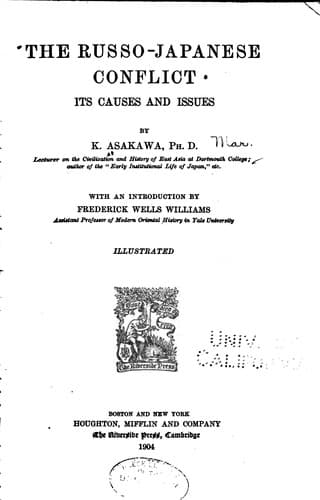
The Russo-Japanese Conflict: Its Causes and IssuesAsakawa, Kan'ichi
History
The Russo-Japanese Conflict: Its Causes and Issues
Asakawa, Kan'ichi
Russo-Japanese War, 1904-1905; Russo-Japanese War, 1904-1905 -- Causes
China, independence of, 203, 205, 208, 209;
integrity of, 203, 205, 208, 297, 303, 305, 310–311, 324, 329, 333,
336, 338, 340 n., 343, 347;
neutrality of, advised by Japan, 363–364,
declared, 365–366;
the open door in, 202, 203, 205, 208, 211.
(Also see _Boxer_, _Court_, _Emperor_, _Manchuria_, and _Russia_.)
Ching, Prince, 94, 162 and n. 2, 177, 182, 191, 192, 193, 196, 214, 228
n. 2, 229, 234, 245, 251, 254, 316.
Chinnampo, 19.
Chishima (the Kuriles), 66 and n. 1, 67.
Conger, 191, 193, 196, 245, 252.
Cotton and cotton goods, 9, 10–11, 41.
Court, the Chinese, leaving for Si-ngan, 161, n. 1;
returning to Peking, 214.
Dalny, as Russia’s Manchurian port, 37–43;
Cassini on, 44;
organization and administration, 133–134;
as a free port, 42, 45 n. 1, 117, 137;
troops leaving for the Korean frontier, 340, 353;
demand for timber, 290.
“Depots” in Manchuria, 44–45, 235;
not to be opened, 315.
_Dōbun-kwai_ = the _Tō-A Dōbun-kwai Hōkoku_, monthly reports of the
Tō-A Dōbun Association.
East Asia, its extent, 8 n. 3;
trade with Japan, 8 and notes;
imports into Japan, 9;
importance to Japan, 9–10.
(Also see _Korea_ and _Manchuria_.)
Eastern Chinese Railway, 32–33, 134, 325;
Company, 96–99, 174, 176, 182, 230.
(Also see _Manchuria_ and _Railway_.)
Education in Japan and Russia, 56 n. 2.
Emperor, Chinese, 176, 177, 182, 183.
Empress Dowager, 219, 245.
England, mediating for China, 68;
declining to join in coercion, 72, 74;
advising Japan to retrocede all Liao-tung, 76;
increasing common interest with Japan and the U. S., 76, 78;
attitude toward the Kiao-chau affair, 106–109;
policy about Talien-wan, 113,
about Port Arthur, 119 ff., 127 n. 2;
at Wei-hai-wei, 107 n. 1, 125–126, 128–129;
reply to Hay, 136;
in South and Middle China, 141–142;
agreement with Germany, 156–161;
interests in Manchuria, 165;
on the Alexieff-Tsêng Agreement, 169;
appealed to by China, 182, 183–184;
on the Lamsdorff-Yang-yu Agreement, 177, 184–185;
on Russian demands, 193, 196;
interests in China, 203, 206, 208;
relations with Japan, 197–199, 205;
agreement with her, 199–208;
protest against Russian demands of 1903, 245, 246, 254;
on Korean neutrality, 255, 360–361.
Equal opportunity, the principle of (definition), 10 and n. 1, 106,
135–138, 139, 159, 165, 202, 205, 208, 211, 297, 303, 305.
Evacuation, the convention of, 93, 196, 214 ff.;
conditions for, 225, 227 ff.;
from the west of Liao, 233 ff., 365–366;
nominal nature of, 234 ff.;
the last day set for, 311;
a new arrangement for, proposed, 311.
(Also see _Manchuria_.)
Far East, vice-royalty of the, 301–302.
Fêng-hwang-Chêng, 155, 239, 292.
Fêng-tien, Province of (Sheng-king), 166.
(Also see _Sheng-king_.)
Finance, Japanese, agriculture in, 4, 5;
army and navy, and total revenue and expenditures, 80, n. 1.
Public-domain text, read in full here on John Shaqi.
Reviews
Reviews
No reviews yet
Be the first to share your thoughts on this work.
Elsewhere in the archive
Join the Discussion
Join the discussion
Sign in to leave a comment or review.
Sign InorCreate an account