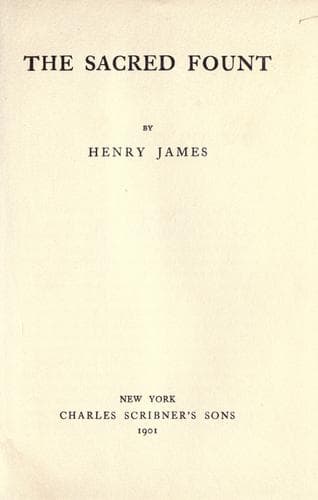
Man-woman relationships -- England -- Fiction; Married people -- England -- Fiction; Psychological fiction
I immediately explained. "Even fighting was working, for we struck,
you'll remember, sparks, and sparks were what we wanted. There we are
then," I cheerfully went on. "Sparks are what we still want, and you've
not come to me, I trust, with a mere spent match. I depend upon it that
you've another to strike." I showed her without fear all I took for
granted. "Who, then, _has_?"
She was superb in her coldness, but her stare was partly blank. "Who
then has what?"
"Why, done it." And as even at this she didn't light I gave her
something of a jog. "You haven't, with the force of your revulsion, I
hope, literally lost our thread." But as, in spite of my thus waiting
for her to pick it up she did nothing, I offered myself as fairly
stooping to the carpet for it and putting it back in her hand. "Done
what we spent the morning wondering at. Who then, if it isn't,
certainly, Mrs. Server, _is_ the woman who has made Gilbert Long--well,
what you know?"
I had needed the moment to take in the special shade of innocence she
was by this time prepared to show me. It was an innocence, in
particular, in respect to the relation of anyone, in all the vast
impropriety of things, to anyone. "I'm afraid I know nothing."
I really wondered an instant how she could expect help from such
extravagance. "But I thought you just recognised that you do enjoy the
sense of your pardonable mistake. You knew something when you knew
enough to see you had made it."
She faced me as with the frank perception that, of whatever else one
might be aware, I abounded in traps, and that this would probably be one
of my worst. "Oh, I think one generally knows when one has made a
mistake."
"That's all then I invite you--_a_ mistake, as you properly call it--to
allow me to impute to you. I'm not accusing you of having made fifty.
You made none whatever, I hold, when you agreed with me with such
eagerness about the striking change in him."
She affected me as asking herself a little, on this, whether vagueness,
the failure of memory, the rejection of nonsense, mightn't still serve
her. But she saw the next moment a better way. It all came back to her,
but from so very far off. "The change, do you mean, in poor Mr. Long?"
"Of what other change--except, as you may say, your own--have you met me
here to speak of? Your own, I needn't remind you, is part and parcel of
Long's."
"Oh, my own," she presently returned, "is a much simpler matter even
than that. My own is the recognition that I just expressed to you and
that I can't consent, if you please, to your twisting into the
recognition of anything else. It's the recognition that I know nothing
of any other change. I stick, if you'll allow me, to my ignorance."
"I'll allow you with joy," I laughed, "if you'll let me stick to it
_with_ you. Your own change is quite sufficient--it gives us all we
need. It will give us, if we retrace the steps of it, everything,
everything!"
Public-domain text, read in full here on John Shaqi.
Reviews
Reviews
No reviews yet
Be the first to share your thoughts on this work.
Elsewhere in the archive
Join the Discussion
Join the discussion
Sign in to leave a comment or review.
Sign InorCreate an account