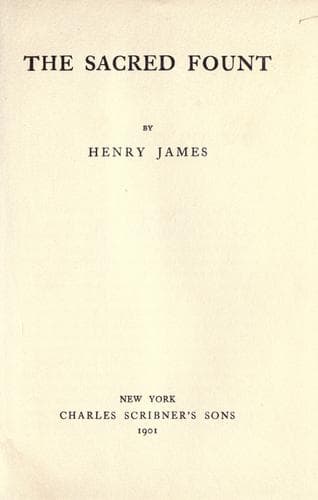
Man-woman relationships -- England -- Fiction; Married people -- England -- Fiction; Psychological fiction
Lady John, as if to be patient with me, looked about at our companions
for a hint of it, wondering which of the ladies I might have been
supposed to "care for" so much as to tolerate in her a preference for a
rival; but the effect of this survey was, I the next instant observed, a
drop of her attention from what I had been saying. Her eye had been
caught by the sight of Gilbert Long within range of us, and then had
been just visibly held by the fact that the person seated with him on
one of the small sofas that almost of necessity made conversation
intimate was the person whose name, just uttered between us, was, in
default of the name she was in search of, still in the air. Gilbert Long
and Mrs. Briss were in familiar colloquy--though I was aware, at the
first flush, of nothing in this that should have made my interlocutress
stare. That is I was aware of nothing but that I had simultaneously
myself been moved to some increase of sharpness. What _could_ I have
known that should have caused me to wonder at the momentary existence of
this particular conjunction of minds unless it were simply the fact that
I hadn't seen it occur amid the many conjunctions I had already
noticed--_plus_ the fact that I had a few minutes before, in the
interest of the full roundness of my theory, actually been missing it?
These two persons had met in my presence at Paddington and had travelled
together under my eyes; I had talked of Mrs. Briss with Long and of Long
with Mrs. Briss; but the vivid picture that their social union forthwith
presented stirred within me, though so strangely late in the day, it
might have seemed, for such an emotion, more than enough freshness of
impression. Yet--now that I did have it there--why should it be vivid,
why stirring, why a picture at all? Was _any_ temporary collocation, in
a house so encouraging to sociability, out of the range of nature?
Intensely prompt, I need scarcely say, were both my freshness and my
perceived objections to it. The happiest objection, could I have taken
time to phrase it, would doubtless have been that the particular effect
of this juxtaposition--to my eyes at least--was a thing not to have been
foreseen. The parties to it looked, certainly, as I felt that I hadn't
prefigured them; though even this, for my reason, was not a description
of their aspect. Much less was it a description for the intelligence of
Lady John--to whom, however, after all, some formulation of what she
dimly saw would not be so indispensable.
Public-domain text, read in full here on John Shaqi.
Reviews
Reviews
No reviews yet
Be the first to share your thoughts on this work.
Elsewhere in the archive
Join the Discussion
Join the discussion
Sign in to leave a comment or review.
Sign InorCreate an account