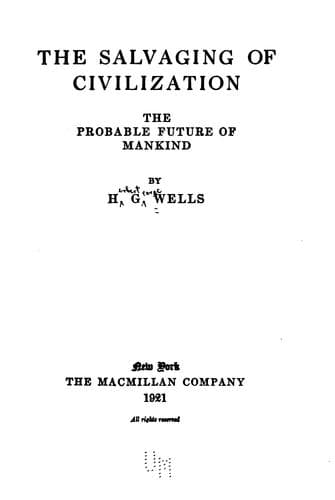
The Salvaging of CivilizationWells, H. G. (Herbert George)
Philosophy
The Salvaging of Civilization
Wells, H. G. (Herbert George)
Civilization, Modern -- 20th century; Education
Now that is the sort of thing that still goes on. But it ought to be
entirely out of date. All that scientific bric-a-brac in the cupboard
had far better be thrown away. All the demonstration experiments that
science teachers will require in the future can be performed once for
all--before a cinematograph. They can be done _finally_; they need never
be done again. You can get the best and most dexterous teacher in the
world--he can do what has to be done with the best apparatus, in the
best light; anything that is very minute or subtle you can magnify or
repeat from another point of view; anything that is intricate you can
record with extreme slowness; you can show the facts a mile off or six
inches off, and all that your actual class teacher need do now is to
spend five minutes on getting out the films he wants, ten minutes in
reading over the corresponding lecture notes, and then he can run the
film, give the lesson, question his class upon it, note what they miss
and how they take it, run the film again for a second scrutiny, and get
out for the subsequent study of the class the ample supply of diagrams
and pictures needed to fix the lesson. Can there be any comparison
between the educational efficiency of the two methods?
So I put it to you, that it is possible now to make--and that the world
needs badly that we should make--a new sort of school, a standardized
school, a school richly equipped with modern apparatus and economizing
the labour of teaching to an extent at present undreamt of, in which,
all over the world, the same stereotyped lessons, leading the youth of
the whole world through a parallel course of schooling, can be
delivered.
I know that in putting this before you I challenge some of the most
popular affectations of cultivated people. I know that many people will
be already writhing with a genteel horror at the idea of the same lesson
being given in identical terms to everybody in turn throughout the
world. It sounds monotonous. It will rob the world of variety--and so on
and so on. But indeed it will not be monotonous at all. That lesson will
be new and fresh and good to every pupil who receives it. And remember
it is by our hypothesis the best possible form and arrangement of that
lesson. It is to take the place of a sham lesson or no lesson at all.
There is an eternal freshness in learning as in all the other main
things in life. It will be no more monotonous than having one's seventh
birthday or falling in love for the first time.
Public-domain text, read in full here on John Shaqi.
Reviews
Reviews
No reviews yet
Be the first to share your thoughts on this work.
Elsewhere in the archive
Join the Discussion
Join the discussion
Sign in to leave a comment or review.
Sign InorCreate an account