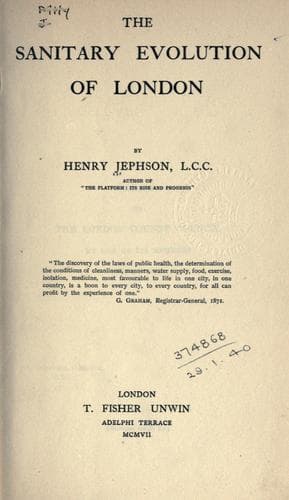
The Sanitary Evolution of LondonJephson, Henry (Henry Lorenzo)
History
The Sanitary Evolution of London
Jephson, Henry (Henry Lorenzo)
Public health -- England -- London
"The daily task of keeping clean their houses and families, once
a pleasure to them as well as a duty, having to be performed amid
overwhelming obstacles on every side, from which no hope of escape
remains to cheer them on, is gradually neglected and ultimately
abandoned, their spirits become torpid and depressed, and this is
necessarily followed by the derangement of the functions of the body.
Finally they become reckless, and this recklessness increases the
evil which gave it birth. There is action and reaction. What marvel
then that, like unto those about them, they float down the ebb tide
towards the dead sea of physical dirt and moral degradation. It has
been truly said by Dr. Southwood Smith, 'The wretchedness being greater
than humanity can bear, annihilates the mental feelings, the faculty
distinctive of the human being.'"
"The heedlessness shown in the building of houses is astonishing.
No care is taken about the nature of the subsoil, the position, the
ventilation, and means of cleanliness. They are run up anywhere and
almost anyhow, and too often become the prolific source of disease."
And he quotes: "No man has a right to erect a nuisance, and the
public has clearly as good a right, as great an interest in enforcing
cleanliness to prevent the outbreak of an epidemic as in requiring
walls to prevent the spread of fire. Yet, where one is destroyed by
fire, how many thousands are there destroyed by disease, the indirect
result of such erections?"
"We are desperately careless about our health, and apparently esteem it
of small value. A great modern writer has truly said: 'The first wealth
is health. No labour, pains, temperance, poverty, nor exercise that can
gain it must be grudged. For sickness is a cannibal which eats up all
the life and youth it can lay hold of, and absorbs its own sons and
daughters.'"
The descriptions here given enable us to realise how terrible and
pitiable a state of things had been reached, and the depths of filth,
and misery, and abomination into which the people had been allowed to
sink through the indifference of Parliament, the absence of any local
government, and the neglect or avarice of the "owners."
One hope there now was. Parliament had at last made laws to remedy
these evils, and local governing authorities had been created to
administer and enforce the laws.
In 1858 a Public Health Act was passed by Parliament, which put an end
to the existence of the Board of Health, and transferred to the Privy
Council the administration of the Diseases Prevention Act. And the
Privy Council was authorised to cause inquiry to be made in relation
to matters concerning the public health. In 1861 a medical department
of the Privy Council was formed which has in many ways been of immense
service to the cause of public health, and which, as time went on,
developed towards a true Ministry of Public Health.
Public-domain text, read in full here on John Shaqi.
Reviews
Reviews
No reviews yet
Be the first to share your thoughts on this work.
Elsewhere in the archive
Join the Discussion
Join the discussion
Sign in to leave a comment or review.
Sign InorCreate an account