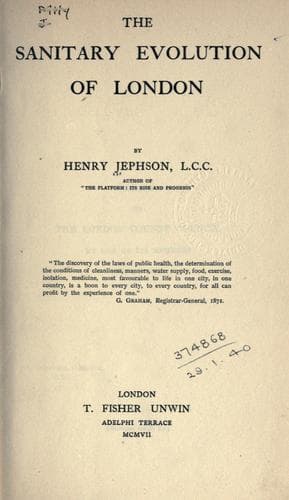
The Sanitary Evolution of LondonJephson, Henry (Henry Lorenzo)
History
The Sanitary Evolution of London
Jephson, Henry (Henry Lorenzo)
Public health -- England -- London
Throughout the central parts of London the process of demolition of
houses of all sorts and sizes, inhabited by the well-to-do or by the
poorest, was continuing. The street improvements which were being
carried out in some places entailed extensive demolitions; whilst
the construction of railways and the erection of large stations
necessitated the destruction of hundreds of others, mostly those
inhabited by poorer persons. Thus, in the improvements in the Holborn
Valley, 348 houses, accommodating 1,044 families and 4,176 persons,
were taken down and not replaced. And in St. Pancras, and many other
districts, the dwellings of the poor were constantly being removed by
railway expansion.
The subject of the displacement of labourers in consequence of great
public works in the metropolis was brought before the House of Lords in
1861 by Lord Derby.[83]
"It affects," he said, "in the most vital manner the interests of a
large portion of the population who are utterly unable to protect
themselves against legislation, however unfavourably it may bear upon
them.
"In the metropolis and its suburbs sixty to seventy miles of new line
(railway) are proposed--a great portion of these passing through the
most crowded streets."
He described specially the parish of St. Bartholomew's, in Cripplegate,
with a population of about 5,000 inhabiting 500 houses.
"Throughout it, there are not ten families who occupy a house to
themselves, although the bulk of the houses contain only three rooms.
The incumbent tells me the aristocracy of his parish consists of
families who are able to indulge in the luxury of two rooms. But the
greater number have one room, and one only, and this is sometimes
divided between more than one family.
"Half of these houses are under notice for the railway."
And Lord Shaftesbury described a great demolition of houses which took
place a few years previously in the neighbourhood of Field Lane, City:
"1,000 houses were pulled down; 4,000 families, comprising 12,000
individuals, were turned out and driven into the surrounding tenements."
Lord Granville suggested, as a remedy, the provision of cheap trains
to carry artizans from healthy dwellings in the suburbs to the scene
of their work, and Lord Redesdale said he had introduced clauses into
the Railway Bill providing that the companies should run a cheap train
every day. But, as Lord Shaftesbury pointed out,[84] that would not be
sufficient, as--
"In some cases the men are under an engagement to their employers not
to live more than a certain distance from the warehouse," in order that
no time might be lost in executing orders.
The remedy, moreover, could only be very gradual in its operation, and
was quite inadequate to meet the existing emergency.
Public-domain text, read in full here on John Shaqi.
Reviews
Reviews
No reviews yet
Be the first to share your thoughts on this work.
Elsewhere in the archive
Join the Discussion
Join the discussion
Sign in to leave a comment or review.
Sign InorCreate an account