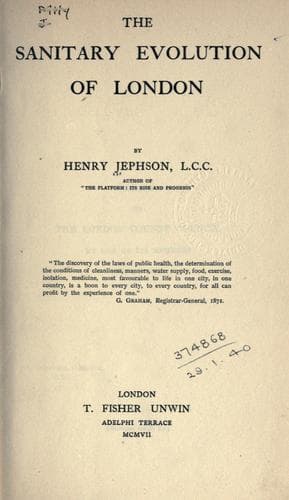
The Sanitary Evolution of LondonJephson, Henry (Henry Lorenzo)
History
The Sanitary Evolution of London
Jephson, Henry (Henry Lorenzo)
Public health -- England -- London
"The numerous improvements which continue to be made in and about the
heart of London have so increased the value of house property that
overcrowding has been almost inevitable.
"... In a vast number of instances families numbering four to seven
persons, ill or well, live, cook, wash, and sleep in rooms the
dimensions of which are not greater than is now demanded for each sick
person in the workhouse."
The Medical Officer of Health for St. George-the-Martyr, Southwark,
wrote:--
"In many of the districts of the metropolis between 60 and 70 per cent.
of the population are compelled to live in one small overcrowded room,
and in which every domestic operation has to be carried on; in it birth
and death takes place; there plays the infant, there lies the corpse;
it is lived in by day, and slept in by night."
In the necessity for house accommodation all sorts of places were being
pressed into use, and people driven into "places that are themselves
unfit for habitation, not having the elements of life and health about
them."
The Medical Officer of Health for Paddington described, in 1867, how
mews had been thus utilised:--
"In fact these back streets, originally built and intended for horses
and vehicles, and only those persons without encumbrances who are
engaged attending to them, have now become the resort of persons
with large families following all kinds of business--rag, bone,
and bottle stores, shops of various kinds, including beer-houses,
builders, carpenters, smiths, tailors, sweeps, find accommodation
here. Inhabiting the rooms above, too small, and unfitted with proper
domestic accommodation for a family, live a vast population of all
ages. These evils, rather than otherwise, are increasing."
Into such houses and such rooms the people were by stress of
circumstances compelled to go, and, as the Medical Officer of Health
for St. Giles' pointed out (1863):--
"A larger rent can be obtained for the same room if it is overcrowded
by a large family than if it be hired for only as many inmates as it
can properly receive. Hence the interests of landlords are constantly
on the one side, the health of the poor on the other...."
What this pressure upon accommodation produced may be gathered from a
few figures given by the Medical Officer of Health for Whitechapel:--
Houses. Rooms. Inmates.
In Slater's Court, Whitechapel 10 31 170
In Marlborough Court 7 20 82
In Hunt Court 8 32 158
"In one room in Swan Court, having one window, seven persons slept--a
man and his wife, the daughter aged 24 in consumption lying in bed, and
four younger children; the cubic contents of the room were 910 = 130
cubic feet to each person.
"In Bell Court four persons occupied a room with 94 cubic feet each.
Public-domain text, read in full here on John Shaqi.
Reviews
Reviews
No reviews yet
Be the first to share your thoughts on this work.
Elsewhere in the archive
Join the Discussion
Join the discussion
Sign in to leave a comment or review.
Sign InorCreate an account