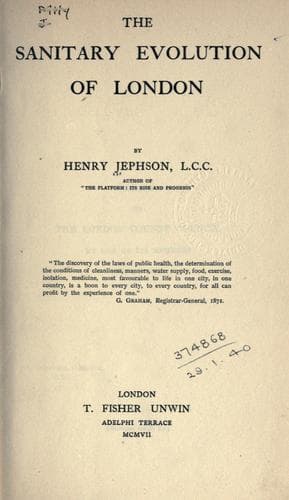
The Sanitary Evolution of LondonJephson, Henry (Henry Lorenzo)
History
The Sanitary Evolution of London
Jephson, Henry (Henry Lorenzo)
Public health -- England -- London
"The objects of which were, first, to provide means for taking down or
improving dwellings occupied by working men which were unfit for human
habitation; and secondly, for the building and maintenance of better
dwellings instead. But the Act of 1868 retained the former only; the
latter having been struck out of the Bill during its progress through
Parliament.
"The intention of Parliament was to provide the means whereby local
authorities might secure the effectual repair of dilapidated dwellings,
or, when necessary, their gradual reconstruction."[114]
The Act conferred powers far exceeding any heretofore possessed by the
local authority for effectually dealing with houses unfit for human
habitation.
"On the report of the Medical Officer of Health that any inhabited
building was in a condition dangerous to health, so as to be unfit for
human habitation, the Vestry, after certain inquiries, &c., was to
have power to order the owner to remove the premises, and, in default,
themselves to remove them; or they might order the owner to execute the
necessary structural alterations, and in default, might either shut up
or pull down the premises, or themselves execute the necessary work at
the owner's expense."[115]
The Act proceeded upon the principle that the responsibility of
maintaining his houses in proper condition falls upon the owner, and
that if he failed in his duty the law is justified in stepping in and
compelling him to perform it. It further assumed that houses unfit
for human habitation ought not to be used as dwellings, but ought, in
the interests of the public, to be closed, and demolished, and to be
subsequently rebuilt.
Use began to be made of the Act soon after its passing, but the
operations under it can be more conveniently described in the following
chapter.
The energy of Parliament had a most beneficial effect, and many of the
Medical Officers of Health bore testimony to the encouraging sanitary
progress which was being made.
Thus the Medical Officer of Health for Fulham wrote (1868):--
"Our district is gradually and most manifestly improving in all those
great features of hygiene which are truly essential where such masses
of people congregate together."
And the Medical Officer of Health for St. Martin-in-the-Fields, who
wrote in 1864 that:--
"The spread of sanitary knowledge is slow"--
Wrote in 1868:--
"Upon the whole, I am of opinion that all classes, even the very
poorest, are much more alive to their own interest in supporting
measures for the maintenance of health."
The Medical Officer of Health for St. Mary, Newington, wrote (1871):--
"The knowledge of a compulsory power, as well as the spread of sanitary
knowledge, and a greater appreciation of it, has led to a vast amount
of sanitary improvement.
Public-domain text, read in full here on John Shaqi.
Reviews
Reviews
No reviews yet
Be the first to share your thoughts on this work.
Elsewhere in the archive
Join the Discussion
Join the discussion
Sign in to leave a comment or review.
Sign InorCreate an account