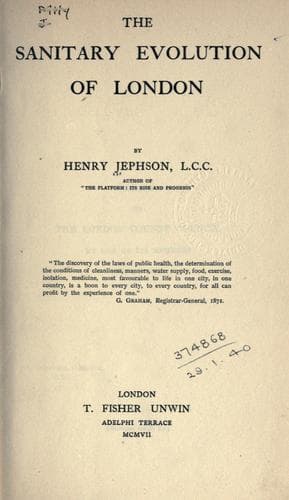
The Sanitary Evolution of LondonJephson, Henry (Henry Lorenzo)
History
The Sanitary Evolution of London
Jephson, Henry (Henry Lorenzo)
Public health -- England -- London
If the conduct of the Vestries and District Boards was reprehensible
for not administering the existing laws for the improvement of the
sanitary condition of the poorer classes, and if the consequences of
their deliberate inaction were so fatal to the lives of countless
thousands of the people and so disastrous to the well-being of the
community, the conduct of the "owners" of the houses, for the manner in
which they allowed their tenants to live, was still more so.
"I often wonder," wrote the Medical Officer of Health for St.
George-the-Martyr (1874-5), "what many of the owners of property think
man was created for except indeed that he should be housed in foul,
wretched dwellings in order that money may be put in their purses,
and so they may reap where they have not sown. A grim kind of harvest
that will prove. Surely the owners have neither humanity nor justice
on their side when they allow their houses to become hotbeds for the
fostering and spreading of disease, moral and physical, and in which
it is impossible either to maintain cleanliness, or support health, or
practice morality. There are thousands of such houses....
"The only true and lasting foundation upon which the glory and safety
of a nation can be built, must be upon the cultivation of the moral and
physical powers belonging to man."
The "owners" were of all classes.
An experienced witness[144] before the Committee of 1881, who had acted
as arbitrator in some of these cases, referring to some of the worst
slum areas in London, said:--
"It came before me that a great many people in life better than that
supposed, do draw considerable incomes from insanitary house property."
"Some of these worst places are held by rich gentlemen and ladies."
"The class of landlords we have here are very shrewd money-making men,
and they would not show much consideration to their tenants."
The Medical Officer of Health for St. George-the-Martyr, Southwark,
reported (1876-7):--
"We have heard denounced, times out of number, and in the strongest
terms, the conduct of the holders of small property as being most
selfish, and they themselves the most persistent and obstinate
opponents of sanitary measures and improvements; and moreover that this
class formed a considerable portion of our Vestries. However this may
be, they cannot claim a monopoly to this unenviable distinction....
"Much of the small class property is placed in the hands of agents who
neither hold nor cultivate any interest in the welfare and comfort of
the tenants.
"To get the most rent with the least possible trouble and outlay seems
to comprise their whole duty (of course there are exceptions).
"How much better in all respects would it be that the owner himself
should give some personal supervision to his property and to the state
of those who dwell in it."
And there was another class of "owners"--the middlemen--"the very curse
that is incident in all society."
Public-domain text, read in full here on John Shaqi.
Reviews
Reviews
No reviews yet
Be the first to share your thoughts on this work.
Elsewhere in the archive
Join the Discussion
Join the discussion
Sign in to leave a comment or review.
Sign InorCreate an account