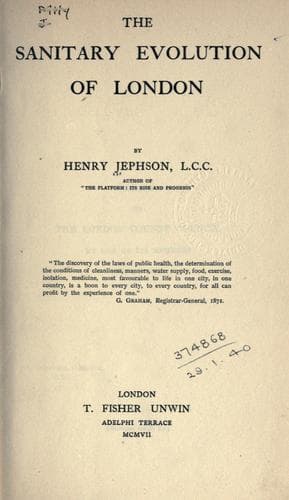
The Sanitary Evolution of LondonJephson, Henry (Henry Lorenzo)
History
The Sanitary Evolution of London
Jephson, Henry (Henry Lorenzo)
Public health -- England -- London
According to Mr. Lyulph Stanley[153] in 1884: "Not one single person
of all the poor displaced in the carrying out of the Gray's Inn Road
improvement, powers for which were obtained in 1877, had been re-housed
by the Board."
The Medical Officer of Health for Whitechapel, in his evidence in 1881,
also showed that many of those in the houses which were to be pulled
down were not working men at all.
"Many of the people do not come into the Whitechapel District for the
purpose of getting employment. They have other motives; they come from
all parts of the country; a great many are tramps, and come up for the
purpose of begging, some for stealing, and some to obtain the advantage
of the charities which exist in London, and many of them to get out of
the way and hide themselves."
By this time, moreover, the possibilities of getting accommodation
further afield was beginning to come into view.
"With the facilities for coming by the early trains and the various
tramways that we have now at a cheap rate, the rents of many of the
inhabitants of Whitechapel would not be increased by moving from it."
That the obligation to re-house was imposed alone upon the public
authorities and upon railway companies was rather inequitable. In
many districts the destruction of houses, and the unhousing of the
inhabitants, was carried out on a far larger scale by private owners,
and no such obligation was imposed upon them. The policy, therefore,
was decidedly onesided, and was very costly to the ratepayer who was in
no way responsible for the proceedings of the private house-owner who
had caused all the trouble.
The Committee reported in June, 1882. They expressed their opinion
that--
"Nothing would contribute more to the social, moral, and physical
improvement of a certain portion of the working classes than the
improvement of the houses and places in which they live."
They stated that "very great hardship would often follow if the
provision for the replacement in or near the area of displacement were
wholly done away with."
"The special calling of many of the work people, the hours of their
work, the employment of their children, the maintenance of their home
life, the economy of living together in a family, the cheapness of food
owing to the nearness of the great evening markets, &c., render it very
desirable that a large portion should be enabled to re-house themselves
in or near their old houses of living, and if no fresh dwellings be
provided the evils of overcrowding will at once increase.
* * * * *
"Still, it is equally true that these observations do not apply to the
whole population. Many without any special calling may live in one
place as well as another. The facilities of transit recently offered by
cheap trains, by boats, by tramways, &c., have enabled many to live in
the suburbs who can do so consistently with their calling."
Public-domain text, read in full here on John Shaqi.
Reviews
Reviews
No reviews yet
Be the first to share your thoughts on this work.
Elsewhere in the archive
Join the Discussion
Join the discussion
Sign in to leave a comment or review.
Sign InorCreate an account