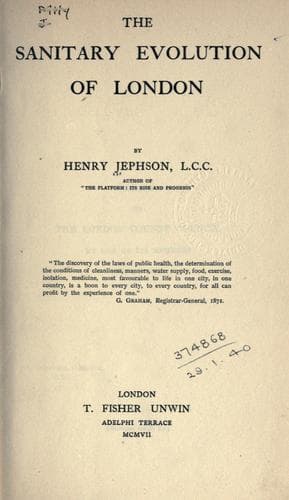
The Sanitary Evolution of LondonJephson, Henry (Henry Lorenzo)
History
The Sanitary Evolution of London
Jephson, Henry (Henry Lorenzo)
Public health -- England -- London
"While London grew," he said,[160] "the Corporation remained
stationary."
"The central body must deal with the large affairs, ... a central body
doing all the great things."
"The central principle of the Bill is this, that there should be some
common control over the Vestries which shall give them a uniform action
for the benefit of the whole community instead of leaving them as they
now are, independent of any such control."
"What is the great evil? It is that the metropolis is broken up into
fragments acting on a different principle, some doing ill, and those
who do well suffering in consequence of the ill-doings of their
neighbours."
"When the danger (of invasion of cholera) threatens a great metropolis
like London, all must desire and want a central authority which should
advise, which should assist, which should compel every part of the
community to take those measures of precaution which are necessary for
the safety of the whole. No such authority exists at this time.
"If a Vestry refuses to make sanitary bye-laws, or to carry out a
proper system of sanitary inspection, you are absolutely powerless
to compel them to do so. A single parish may become a plague-spot
in London from which disease may be spread all around, and the
Metropolitan Authority have no authority to make the parish do as it
ought to do."
Mr. Gladstone said[161]:--
"The local government of London is, or, if it is not, it certainly
ought to be, the crown of all our local and municipal institutions.
"The principle of unity (of London) has already been established under
the pressure of necessity as a matter which could not be resisted. It
has been established in the Metropolitan Board of Works.... There can
be no doubt we have established a principle of unity, and that we have
found it satisfactory.
"The supply of water and the supply of gas ... two of the most
elementary among the purposes of municipal government, have been
handed over to private Corporations for the purpose of private profit
because you have not chosen to create a complete municipality for the
metropolis.
"And that is not all.
"The defects of the present system are admitted.... Surely if there
are these great and intolerable defects they ought to be remedied by
the action of some genuine popular local authority. But we have got no
genuine popular local authority....
"London, large as it is, is a natural unit--united by common features,
united by common approximation, by common neighbourhood, by common
dangers--depending upon common supplies, having common wants and common
conveniences.
"... Unity of Government in the metropolis is the only method on which
we can proceed for producing municipal reform."
The Bill was strongly opposed in Parliament, and was withdrawn at
a late period of the Session, "but its introduction and discussion
had done much to awaken interest and mature opinion on the question
of the practicability of the government of London by a single
municipality."[162]
Public-domain text, read in full here on John Shaqi.
Reviews
Reviews
No reviews yet
Be the first to share your thoughts on this work.
Elsewhere in the archive
Join the Discussion
Join the discussion
Sign in to leave a comment or review.
Sign InorCreate an account