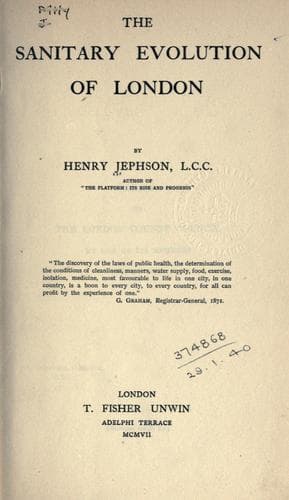
The Sanitary Evolution of LondonJephson, Henry (Henry Lorenzo)
History
The Sanitary Evolution of London
Jephson, Henry (Henry Lorenzo)
Public health -- England -- London
Some interesting descriptions of some of these "middlemen" were given.
One of the largest in Clerkenwell was a Mr. Decimus Ball, and there was
also a Mr. Ross--both of whom were on the Vestry.
The witness stated that these men had neglected the houses, and in many
cases were very extortionate in their demands against the occupants.
Mr. Ball had many houses which were inhabited by families in single
rooms, but which up to a short time previously were inhabited by whole
families to a house.
Mr. Ball's profit is "perfectly enormous if he does not do any
repairs." And he made very few; and if the rent were not paid on the
Monday morning, he threatened to raise it.
Probably the most notorious "middleman" was a certain Mr. Flight.
"He must have been the owner of thousands and thousands of houses in
the metropolis." (18,000, it was said.)
"He owned property in every part of London, and the squalid nature of
that property, the wretched condition in which it has been kept, the
avoidance of all decent rules by which habitations are governed, was
something very fearful."
"Middlemen," it was stated, sometimes appeared to be making 150 per
cent. per annum, but they assert that repairs have to come out of that.
Repairs, however, were only executed once in three or four years, and
in the others they get their 150 per cent.
"If the house-farmers do no repairs for years the profits are large....
They collect their rents very sharply.
"The middleman makes the tenant pay an excessive rent because he
insists upon making an excessive profit."
The great work which the Commission did was in the enlightenment of
the public, and the material they afforded for the formation of public
opinion in the right direction. Subsequent experience showed that
the recommendations made--excellent and helpful as so many of them
were--did not by a long way cut deep enough to extirpate the more
serious evils.
"It is evident," wrote the Commissioners, "that the 35th Section of
the Sanitary Act of 1866 (dealing with tenement-houses) which contains
a remedy for some of the evils which have been described is likely to
remain a dead letter in many districts of the metropolis until some
improved means be devised for putting it into action." They recommended
that the local authorities who had not already made and enforced
bye-laws under the section "should proceed to do so."
But no compulsion was suggested to make them do so, or for the only
effective alternative, the provision of other machinery to act in their
default, and so the local authorities were in this matter allowed to
remain in their position of complete independence and to continue their
policy of inactivity--if not obstruction.
As to inspection, and the inadequacy of a sanitary staff, much evidence
had been given, but, they remarked:--
Public-domain text, read in full here on John Shaqi.
Reviews
Reviews
No reviews yet
Be the first to share your thoughts on this work.
Elsewhere in the archive
Join the Discussion
Join the discussion
Sign in to leave a comment or review.
Sign InorCreate an account