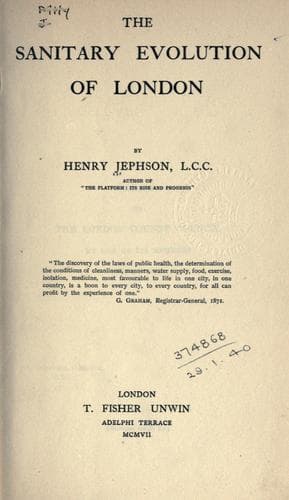
The Sanitary Evolution of LondonJephson, Henry (Henry Lorenzo)
History
The Sanitary Evolution of London
Jephson, Henry (Henry Lorenzo)
Public health -- England -- London
And these were the men who made the loudest protests and outcry against
legislation and against administration which was to make them do that
which the vital interests of the community and of the State required to
be done.
The root of the evil connected with the housing of the people in London
lay with the disregard of "owners" for the condition of their tenants.
Many "owners" appeared to be under the impression that their investment
in house property was to be as free from trouble or labour as money
invested in the national funds is; and so long as they got the rent
they expected, they did not trouble themselves about the state of
the houses or of the people living therein. They were loth to spend
money on them, as that curtailed their income, and the argument was
constantly used that it was useless spending money to put the property
in order, when anything they did to it would be promptly destroyed.
And they cared not who were their tenants so long as a high rent was
obtainable from them.
Some declared that the people were so sunken, so degraded, so filthy,
and depraved, and destructive, that nothing they could do could secure
their property being kept in a sanitary or decent condition.
Doubtless in many districts and many cases the conduct of the tenants
was as bad as bad could be. As one of the Medical Officers of Health
wrote in 1883:--
"It must be borne in mind that many of the occupants of tenement
property are careless and filthy in their habits; and in addition are
very destructive; fittings put up one day are pulled down and destroyed
the next; ash-bin covers, closet doors, and even flooring boards, share
the same fate."
And many were the "owners" of various degree who endeavoured to justify
their neglect on this ground.
Were such an argument admitted, the owner could claim to be exonerated
from the duty of keeping his property in proper order, and the evil
conditions and consequences resulting from his neglect would go on
increasing indefinitely, until a state of things destructive to the
community was ultimately reached.
Viewed broadly, and impartially, there was much truth as regarded the
misconduct and uncleanliness of great numbers of tenants, but the
central fact was that the "owner" was the person mainly interested in,
and benefited by possession of the property, and therefore primarily
responsible for maintaining it in a condition which should not endanger
the health of the community.
If, through the neglect and indifference of his predecessors, the
property had fallen into a bad state, the consequences equitably fell
upon him, just as the consequences of any other bad investment by his
predecessor would have done. He had inherited something which was not
worth as much as he anticipated--that was all; but the consequences
must not be shifted on to the community, nor must his tenants be made
the victims.
Public-domain text, read in full here on John Shaqi.
Reviews
Reviews
No reviews yet
Be the first to share your thoughts on this work.
Elsewhere in the archive
Join the Discussion
Join the discussion
Sign in to leave a comment or review.
Sign InorCreate an account