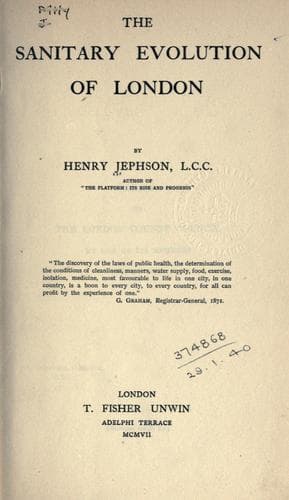
The Sanitary Evolution of LondonJephson, Henry (Henry Lorenzo)
History
The Sanitary Evolution of London
Jephson, Henry (Henry Lorenzo)
Public health -- England -- London
In other parishes and districts the number registered and inspected
was but a fraction of the houses which ought to have been registered.
In Bow (in Poplar) where none were registered, the Medical Officer of
Health wrote in 1891: "I should say 4,000 houses require registration."
In St. Mary, Newington: "At least 80 per cent. of the houses are
occupied by members of more than one family." But as yet none were
registered. And this same Medical Officer of Health pointed out how in
his parish--"The indisposition that has hitherto been shown on the part
of the Vestry to put into force the bye-laws for houses let in lodgings
has led to great license in house-farming and house-crowding."
Where really put into operation the regulations had an excellent
effect. Thus the District Board of St. Giles' said: "The advantage of
these regulations has been very great."
And in Paddington the Medical Officer of Health stated: "The work done
... has had an excellent effect."
Of some streets where houses were registered (1897-8)--"The
whitewashing and cleansing has without doubt had a good effect. The
streets have been freer from infectious diseases than they have been
for several years past."
The advantages of the regulations in the administration of the health
laws were time after time pointed out and insisted upon by many Medical
Officers of Health.
The Medical Officer of Health for Westminster, where nearly 1,000
houses were registered, wrote (1899):--
"The great advantage in legal procedure lies in the fact that a breach
of them is a finable offence with a further daily penalty after written
notice, and is not a nuisance subject to abatement within a certain
time.
"If the conditions imposed by the bye-laws are carried out, no doubt
one of the best methods for preventing overcrowding is thus achieved."
The advantage of this quicker procedure was manifest, for, under the
other Public Health or Sanitary Acts, the whole process of dealing
with, or getting a nuisance abated, took "a long time--a very long
time," but the advantages did not appeal to people who did not want to
use them.
Thus there was a most grievous neglect of duty on the part of the great
majority of the Vestries and District Boards, with the inevitable
result of the most disastrous consequences to the working and poorer
classes all over London.
It must have appeared strange, in view of this glaring and scandalous
neglect of duty by the Vestries in enforcing the regulations, that the
London County Council as the Central Authority did not use the powers
which they were supposed to possess of acting in the default of the
local authorities, or of making representation to the Local Government
Board of the neglect of those authorities.
Public-domain text, read in full here on John Shaqi.
Reviews
Reviews
No reviews yet
Be the first to share your thoughts on this work.
Elsewhere in the archive
Join the Discussion
Join the discussion
Sign in to leave a comment or review.
Sign InorCreate an account