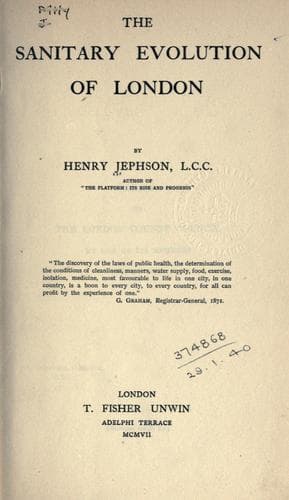
The Sanitary Evolution of LondonJephson, Henry (Henry Lorenzo)
History
The Sanitary Evolution of London
Jephson, Henry (Henry Lorenzo)
Public health -- England -- London
The right to give notice to the sanitary authority of the existence
of a nuisance was extended, and the process was facilitated. Notice
might be given to the sanitary authorities by the person aggrieved,
by the sanitary inspector, or by a constable, or by two inhabitant
householders of the parish; and certain powers of entry were given
to the local authority or their officer. The justices who heard the
case might require the person offending to provide sufficient sanitary
accommodation, means of drainage, or ventilation, to abate the
nuisance, or to whitewash, disinfect, or purify the premises which were
a nuisance, and could inflict a fine for contravention of the order of
abatement; and, if the nuisance proved to exist were such as, in their
judgment, to render a house unfit for human habitation, they were given
authority even to prohibit the using thereof until it was rendered fit.
Furthermore, as regarded certain noxious trades, including
slaughter-houses and manufactories causing effluvia, which were
certified by the Medical Officer of Health to be a nuisance, or
injurious to the health of the inhabitants of the neighbourhood, the
owner or occupier of the premises might be proceeded against, and, on
conviction, fined.
Against the monster evil of "overcrowding" Parliament made an attempt
to legislate specifically, thus formally recognising the necessity for
dealing with it.
"Whenever the Medical Officer of Health shall certify to the local
authority that any house is so overcrowded as to be dangerous or
prejudicial to the inhabitants, and the inhabitants shall consist of
more than one family, the local authority shall cause proceedings to be
taken before the justices to abate such overcrowding, and the justices
shall thereupon make such order as they may think fit, and the person
permitting such overcrowding shall forfeit a sum not exceeding forty
shillings."
And an effort was also made to curtail the practice of living in
underground rooms and cellars by defining what such a room or cellar
was, and making liable to a penalty "whoever let, occupied, or
knowingly suffered to be occupied, any room or cellar contrary to the
Act."[57]
As money was essential for the working of the Acts, over and above
that for which rates could be levied, power was given both to the
Metropolitan Board of Works and to the Vestries and District Boards of
Works to borrow money on the security of the rates, and repayable by
instalments, "provided always that no money should be so borrowed by
Vestries or District Boards without the previous sanction in writing of
the said Metropolitan Board."
There were to be auditors of the accounts of the local authorities, who
were to be annually elected at the same time and in the same manner as
members of the Vestry.
Public-domain text, read in full here on John Shaqi.
Reviews
Reviews
No reviews yet
Be the first to share your thoughts on this work.
Elsewhere in the archive
Join the Discussion
Join the discussion
Sign in to leave a comment or review.
Sign InorCreate an account