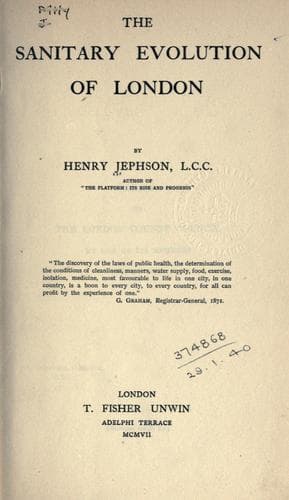
The Sanitary Evolution of LondonJephson, Henry (Henry Lorenzo)
History
The Sanitary Evolution of London
Jephson, Henry (Henry Lorenzo)
Public health -- England -- London
Finally, each Vestry and District Board of Works was to make to the
Metropolitan Board of Works an annual report of its proceedings,
including a report from the Medical Officer of Health; and the
Metropolitan Board was to make an annual report of its proceedings, and
present a copy to one of Her Majesty's Secretaries of State.
The third of these Acts, "The Metropolitan Building Act, 1855," amended
the existing laws relating to buildings in the metropolis, and laid
down an elaborate code for the regulation and supervision of all new
buildings. Most of this code related to the structure--the thickness of
walls, &c., &c.--and had primarily in view the security of the house
from destruction by fire. Only a few sections in the Act related to the
infinitely more important matter of adequate provision for the health
of the inhabitants, and those dealt with it in the most niggardly way.
A minimum of one hundred square feet was laid down as satisfying the
requirements of open space for air and ventilation around a dwelling; a
minimum of seven feet in height was held to satisfy the requirements of
any room in a house.
And the supervision of every building, and every work done in or upon
any building, was entrusted to the "District Surveyors"--officials
taken over by the Metropolitan Board from the previous body, appointed
under the Building Act of 1844, which had distinguished itself by its
incapacity.
These Acts practically laid down the framework of the machinery of the
sanitary government of London, and struck the first real blow at the
roots of the insanitary condition of the metropolis.
The callous indifference and inaction of generations had left not a
mere Augean stable to be cleansed, but a great city over 100 square
miles in extent and containing two and a half millions of people, and
the new authorities, when they came into existence, had not only to
meet the daily needs of a vast existing population, but to make good
the neglect of centuries, and to build up a sound and effective working
system of sanitary administration.
The task lying before them was one of enormous proportions, for on them
rested the responsibility of effecting the sanitary redemption of the
millions of the metropolis--as well as the infinitely greater duty of
safeguarding future generations from similar sufferings and wrongs.
It was, moreover, a task of almost superhuman difficulty, for arrayed
against reform and amelioration were the powerful forces of "vested
rights in filth and dirt." And adding to the difficulty was the huge
inert mass of ignorance, and poverty, and helplessness of masses of the
people.
One principle contained in these Acts was of pre-eminent
consequence--namely, the responsibility of "ownership." Hitherto owners
had effectually escaped all responsibility as regarded the sanitary
state of their property, and had dealt with their property exactly
as they pleased, and regardless of the consequences to any one but
themselves.
Public-domain text, read in full here on John Shaqi.
Reviews
Reviews
No reviews yet
Be the first to share your thoughts on this work.
Elsewhere in the archive
Join the Discussion
Join the discussion
Sign in to leave a comment or review.
Sign InorCreate an account