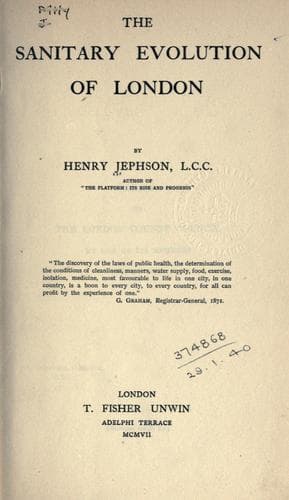
The Sanitary Evolution of LondonJephson, Henry (Henry Lorenzo)
History
The Sanitary Evolution of London
Jephson, Henry (Henry Lorenzo)
Public health -- England -- London
The local authorities, with simpler duties to perform, were able to get
quicker to work.
They appointed "Surveyors" in each parish to look after the
multifarious duties in connection with the paving, lighting, and
cleansing of the streets, with scavenging, and the removal of house and
trade refuse, and with the construction and maintenance of local sewers
and drains. In a sort of way some of this work had been done by the
previous petty authorities; parts of it, therefore, were more or less
familiar, and so not wholly new.
But wholly new, and of very great importance, were the appointments
which the new local authorities had to make for their districts of a
Medical Officer of Health, and of one or more Inspectors of Nuisances
to help him.
The duties of the Medical Officer of Health were carefully prescribed
by the Act. He was to inspect and report periodically upon the sanitary
condition of the parish; to ascertain the existence of diseases
increasing the rate of mortality; to point out the existence of any
causes likely to originate or maintain such diseases, as well as to
suggest the most efficacious mode of checking and preventing their
spread, and various other important sanitary duties.
These appointments were duly made, and some appointments also of
Inspectors of Nuisances.
Herein was involved the clear recognition of another principle of the
utmost consequence--that of inspection--a principle very naturally
held in abhorrence by all sanitary misdoers. It had previously been
put spasmodically into operation, and with the best effects, on the
occasions when Asiatic cholera was approaching or raging in the
country, but when the panic had subsided it was promptly dropped, and
every one was practically left free to commit any sanitary enormity
with impunity. Henceforth, however, there would be the contingency of
being found out for breaches of sanitary laws, and the eye of the law
would, at least theoretically, be upon sanitary law breakers.
The majority of the Medical Officers of Health entered energetically
on their work, and thenceforward a constant light was thrown upon the
sanitary condition of various parts of the metropolis by men who lived
in the closest and most unceasing contact with the devastating evils
afflicting the masses of the people. All were not equally efficient
or energetic--all were not equally communicative--but the reports of
many of them are full of interesting facts, of acute and instructive
comment, and of wise counsel; and though holding office at the
pleasure of their employers, many of these officers were courageously
independent and outspoken in their criticism and advice.[58]
Unfortunately, the reports had practically no circulation beyond the
members of the bodies to whom they were made, if even they were read by
them, and the recommendations made therein were too often absolutely
ignored by those bodies, or, for reasons of self-interest, opposed.
Public-domain text, read in full here on John Shaqi.
Reviews
Reviews
No reviews yet
Be the first to share your thoughts on this work.
Elsewhere in the archive
Join the Discussion
Join the discussion
Sign in to leave a comment or review.
Sign InorCreate an account