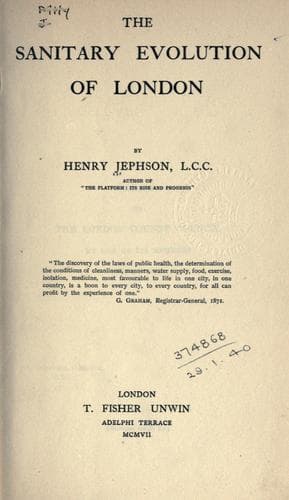
The Sanitary Evolution of LondonJephson, Henry (Henry Lorenzo)
History
The Sanitary Evolution of London
Jephson, Henry (Henry Lorenzo)
Public health -- England -- London
Parliament now formally recognised and definitely laid down the
principle that the "owner" was the person responsible for the
insanitary condition of his property; and in addition declared that
individuals would not in future be allowed to deal with their property
in such a manner as to cause injury to the public health.
But declaration of principles was one thing--their enforcement was
another. Unfortunately, those who were charged with their enforcement
were too often the persons directly interested in resisting reform,
and in very many instances, where even a partial enforcement of these
principles was attempted, the action was resented and vigorously
resisted.
The Metropolis Local Management Act came into force on January 1,
1856, and the Central Authority--the Metropolitan Board of Works--and
the local authorities--Vestries and District Boards--having been duly
elected, entered upon their duties.
The first and most urgent work which the Metropolitan Board was
charged to carry out was the main drainage of the metropolis, and at
the outset, the new Board directed its efforts almost exclusively to
the highly technical task of devising and considering and adopting
plans for the construction of a great system of sewerage which should
intercept the flow of sewage into the Thames, and should convey it by
other means to a safe distance below London, whence it might flow into
the sea.
Any plan had, however, to be approved by the Chief Commissioner of
Works. To him the Board submitted three plans, but none of them
received such approval, and the matter was at a deadlock until 1858,
when an Act was passed removing the veto of the Chief Commissioner of
Works, and at the same time giving the Metropolitan Board power to
raise a loan of £3,000,000, which up to that time it had no power to do.
Within a week from the passing of that Act, the Board determined on a
plan, and began arrangements for carrying it out.
The plan adopted was to intercept all the sewage flowing into the
Thames within the area of the metropolis, and to convey it by sewers
to a distance, and to discharge it into the river at such a condition
of tide as should take it still further out, so as not to return and
become a nuisance to the metropolis. The proposed interception on the
north side was by three main sewers, discharging at Barking--the upper,
the middle, and the lower, with branches; on the south side, by two
main sewers, discharging at Crossness.
As the result of the Act there had been transferred to the Board 106
miles of main sewers on the north side of the Thames with 33 outlets
into the river, and 60 miles on the south side with 31 outlets. A
considerable number of these were offensive open sewers, others
were defective in design and construction, whilst all required
reconstruction to make them effective, and to fit them for connection
with the new system.
The Central Authority had thus a heavy task before it, and one which it
would take years to perform.
Public-domain text, read in full here on John Shaqi.
Reviews
Reviews
No reviews yet
Be the first to share your thoughts on this work.
Elsewhere in the archive
Join the Discussion
Join the discussion
Sign in to leave a comment or review.
Sign InorCreate an account