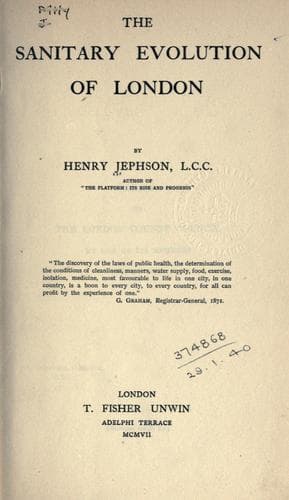
The Sanitary Evolution of LondonJephson, Henry (Henry Lorenzo)
History
The Sanitary Evolution of London
Jephson, Henry (Henry Lorenzo)
Public health -- England -- London
How then can the subject be best treated with the object of presenting
the main facts of the sanitary evolution of London, and deducing from
them the lessons of experience and guidance for the future?
Probably by a sort of compromise between these two methods--taking
groups of districts instead of separate districts--and groups
of matters pertaining to the public health, instead of separate
subjects--and, furthermore, dealing with the whole subject in certain
definite periods. Groups of parishes have already, for certain health
purposes, been classified into central, eastern, northern, western, and
southern. That classification can be adhered to here.
And inasmuch as almost the only reliable statistics as to many matters
relating to the public health are those afforded every decade by the
census, the narrative can best be treated by taking decennial periods,
and utilising the reliable information of the census for the deduction
of conclusions which on any other basis might be unsound. This method,
then, though in many respects imperfect, is adopted as probably the
best for tracing the sanitary evolution of the great metropolis.
Foremost among the central group, but standing by itself, and in the
main outside the scope of the legislation, was the "City." To the
description of its condition already given nothing need be added beyond
the statement of the fact that the great economic forces at work
therein were displaying their results in the "City" itself in very
striking manner.
Under their potent influence the population there had begun to rapidly
decline. In 1851 it had been 127,533. In 1861 it had come down to
111,784. The number of inhabited houses was likewise rapidly declining.
In 1851 there had been 14,483; in 1861 there were 13,218. Under the
irresistible demands for greater business and trading accommodation,
the inhabited houses there were being rapidly converted to the more
profitable purpose of business offices, or warehouses.
As the number of business premises and shops increased in a locality,
so did the better-to-do residents leave it, and migrate to pleasanter
or more healthy localities. Some of the houses thus vacated became
promptly tenanted by numerous families of a lower, or even the lowest
classes; until they too were converted to business purposes, and their
inhabitants once more turned adrift to seek other habitation. Some of
these people secured in the neighbouring parishes residence in one or
part of one of those jerry-built and insanitary constructions which
land-owners and builders were erecting as rapidly as possible upon
any unbuilt ground which they owned, or which they could lay hands
upon--the majority contented themselves with squeezing somehow into
tenement houses already overcrowded.
Public-domain text, read in full here on John Shaqi.
Reviews
Reviews
No reviews yet
Be the first to share your thoughts on this work.
Elsewhere in the archive
Join the Discussion
Join the discussion
Sign in to leave a comment or review.
Sign InorCreate an account