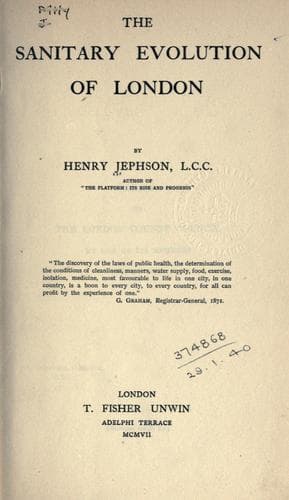
The Sanitary Evolution of LondonJephson, Henry (Henry Lorenzo)
History
The Sanitary Evolution of London
Jephson, Henry (Henry Lorenzo)
Public health -- England -- London
And that is what, undoubtedly, it amounted to. Hitherto the
"individuals" had had their own way unchallenged and unchecked, and
countless thousands of the community had been sent to their doom. Now,
in a sort of way, it was to be a war--a very just and necessary, and on
the part of the community a bloodless war--to enforce upon land-owners,
and house-owners and house-middlemen, obedience to the principle that
"property has its duties as well as its rights," and that those
individual rights should not be exercised--as they had hitherto so
cruelly been--to the mortal injury of vast numbers of the community.
And there was yet another aspect of their work being a war. It was war
against disease and filth, and all the causes of insanitation, and
against the consequent human suffering and misery, and degradation, in
some of the very worst forms.
That, unfortunately, was a never-endable war. Great successes might be
won--complete and final victory never.
The central group of parishes and districts outside the "City"--and
lying to the north and west of the "City," consisted of St.
Luke, Clerkenwell, Holborn, St. Giles', the Strand, and St.
Martin-in-the-Fields, with a population of close upon 288,000--about
one-ninth of that of the metropolis. Already in four of these, under
the influence of the economic forces already described, the population
was decreasing. Every portion of this central group was densely
populated, and it contained two of the most crowded of all the areas
of the metropolis--the Strand, which stood highest, and St. Luke's,
which had "the questionable distinction" of being the second most
densely populated parish. In St. Giles', which was "amongst the oldest,
most densely peopled, and most deteriorated portions of London," the
population in 1851 "did not appear capable of further increase, the
district being incapable of expansion either by packing closer or by
the addition of new houses."
The eastern group consisted of the parishes or districts of Shoreditch,
Whitechapel, Bethnal Green, Mile-End-Old-Town, St. George-in-the-East,
Limehouse, and Poplar.
In Whitechapel the population was stationary; in all the others
increasing.
The northern group of parishes and districts consisted of Hackney,
Islington, St. Pancras, St. Marylebone, and Hampstead.
In every one of these the population was on the increase, slightly in
St. Marylebone, very rapidly in most of them, notably so in St. Pancras
and Islington.
The western group consisted of Westminster, St. James', St. George
(Hanover Square), Paddington, Kensington, Fulham, and Chelsea.
In St. James' the population was decreasing (having reached its apogee
in 1841); in Westminster it was slightly increasing; in all the others
rapidly increasing.
Public-domain text, read in full here on John Shaqi.
Reviews
Reviews
No reviews yet
Be the first to share your thoughts on this work.
Elsewhere in the archive
Join the Discussion
Join the discussion
Sign in to leave a comment or review.
Sign InorCreate an account