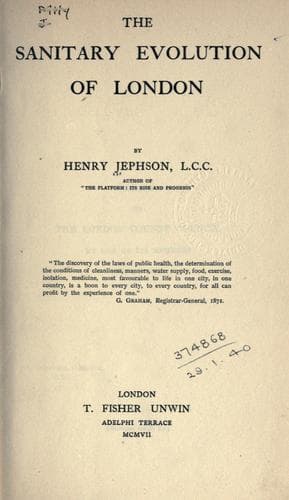
The Sanitary Evolution of LondonJephson, Henry (Henry Lorenzo)
History
The Sanitary Evolution of London
Jephson, Henry (Henry Lorenzo)
Public health -- England -- London
In St. Giles' (1858-9), "the water of the wells was not deemed good
enough (on analysis) for watering the roads." In St. Marylebone "44
public wells supplied water which was for the most part offensive to
taste and smell." In Kensington (1860) "all the well waters of the
parish were foul." In Rotherhithe (1857), "The water from the tidal
well smelt as if it had recently been dipped from a sewer."
The Medical Officer of Health for Lambeth declared (1856) that "the
shallow well waters of London combined the worst features--they
represent the drainage of a great manure bed."
The people were driven to the use of the water from these wells owing
to the deficient and intermittent supply of water by the various Water
Companies--water supplied for less than an hour a day by one single
stand-pipe in a court containing hundreds of people--water supplied
only every second and third day, and none on Sundays, the day of all
others on which it was most wanted; and the house-owners had provided
no cisterns or reservoirs of proper capacity, and the Vestries had not
compelled the house-owners to do so.
In some parishes hundreds of houses had no supply at all. In some
houses which had a supply the tenants were deliberately deprived
thereof by the Water Companies, because the house-owner had not paid
the water-rate.
The defective supply had the disastrous effect of putting a constant
premium upon dirt--dirt of person, of room, of houses, and their
surroundings. And such drains and sewers as there were, were
insufficiently flushed.
Time after time the consequential evils were pointed out, and Water
Companies and house-owners were vigorously censured. But the censure
had little practical effect.
The great inconveniences and evils, however, evoked the expression of
opinion that the duty of supplying water to the community ought to be
in the hands of the community.
Even in 1844 it had been pointed out that:--
"Water is as indispensable for many purposes as air is for life itself,
and its supply ought not to be allowed to depend on the cupidity or
caprice of landlords or Water Companies."
And the Metropolitan Sanitary Association had enunciated the
principle:--
"That inasmuch as water is a prime necessity of life, attainable in
large cities by combined effort only, and not to be denied to any
without injury to all, its supply should not be dependent on commercial
enterprise, but be provided at the expense of the community for the
common benefit."
And the Medical Officer of Health for St. George-in-the East wrote in
1856:--
Public-domain text, read in full here on John Shaqi.
Reviews
Reviews
No reviews yet
Be the first to share your thoughts on this work.
Elsewhere in the archive
Join the Discussion
Join the discussion
Sign in to leave a comment or review.
Sign InorCreate an account