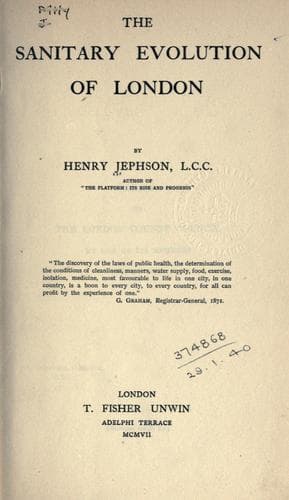
The Sanitary Evolution of LondonJephson, Henry (Henry Lorenzo)
History
The Sanitary Evolution of London
Jephson, Henry (Henry Lorenzo)
Public health -- England -- London
The greater the light thrown upon the sanitary condition of the people
of London, the clearer became the fact that the principal blame
therefor rested upon the house-owner, lessee, or middleman, or as
Parliament defined him, "the owner."
Many of the Medical Officers of Health were outspoken and unhesitating
in their opinion as to the responsibility of the house-owner for the
existing condition of the dwellings of the people.
"The enemies of the poorer classes," wrote the Medical Officer of
Health for Clerkenwell, "are the landlords, who know well that proper
lodgings for the really poor do not exist. They know also that if they
buy at a cheap rate any old premises not fit for a pig-sty and let them
cheaply they will be sure to find tenants."
If it was not the real owner of the house, it was the middleman or
person or persons between the owner and the tenant. Rents were high in
most parts of London where there was urgent demand for accommodation,
and "the yearly rental is unfortunately in many cases still further
increased by the 'middleman system'; many of the houses being rented by
an individual who sub-lets them in separate rooms as weekly tenancies,
and this at an increase of 20 per cent. (Strand 1856):--
"And thus it is that health and life are daily sacrificed at the shrine
of gain."
What sort of property some of them held, and the condition in which
they allowed it to remain, whilst they drew their "gain" from it,
is graphically illustrated by the Medical Officer of Health in St.
Olave's, Southwark (1856).
He thus described the houses in three small courts:--
"The whole of these houses are held by one person, and it is impossible
to imagine any state much worse than the condition of everything
connected with their drainage, &c.
"Here, within a small area, are thirty-nine houses, all having open
foul privies, cesspools all filled, and many overflowing. The yards
are foul, dirty, damp, and wretchedly paved with small, loose, broken
bricks--most of them are daily filled with the overflowing of the
drains and cesspools, the drains are all untrapped, and scarcely a
house has a proper receptacle for water; they are mostly broken,
dilapidated, uncovered tubs, placed close to the cesspools, so as to
absorb the foul gases emanating from them. The effluvium on entering
any of these places is abominable, and greatly complained of....
"These three courts are thickly inhabited."
In the following month he reported nineteen houses in two streets very
much the same as above. In the next month twenty more--in the month
after, thirty more. He might almost have had the general description
printed, with blanks for filling up the number of such houses and where
situated.
Public-domain text, read in full here on John Shaqi.
Reviews
Reviews
No reviews yet
Be the first to share your thoughts on this work.
Elsewhere in the archive
Join the Discussion
Join the discussion
Sign in to leave a comment or review.
Sign InorCreate an account