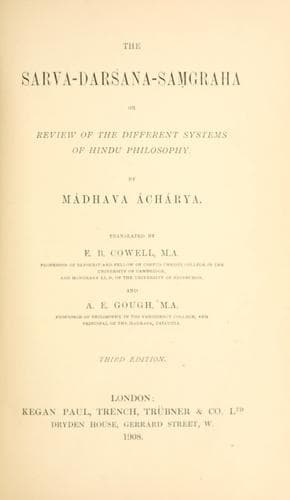
The Sarva-Darsana-Samgraha: Or, Review of the Different Systems of Hindu PhilosophyMadhava
ReligionEastern
The Sarva-Darsana-Samgraha: Or, Review of the Different Systems of Hindu Philosophy
Madhava
Philosophy, Hindu; Philosophy, Indic
Now "concentration" [_yoga_] consists [by i. 2] in "the suppression of
the modifications of the thinking principle," which stops the
operation of the "afflictions," &c.; and this "suppression" is not
considered to be merely the non-existence of the modifications
[_i.e._, a mere negation], because, if it were a mere negation, it
could not produce positive impressions on the mind; but it is rather
the site of this non-existence,[426]--a particular state of the
thinking principle, called by the four names [which will be fully
described hereafter], _madhumatí_, _madhupratíká_, _viśoká_, and
_saṃskáraśeshatá_. The word _nirodha_ thus corresponds to its
etymological explanation as "that in which the modifications of the
thinking principle, right notion, misconception, &c., are suppressed
(_nirudhyante_). This suppression of the modifications is produced by
"exercise" and "dispassion" [i. 12]. "Exercise is the repeated effort
that the internal organ shall remain in its proper state" [i. 13].
This "remaining in its proper state" is a particular kind of
development, whereby the thinking principle remains in its natural
state, unaffected by those modifications which at different times
assume the form of revealing, energising, and controlling.[427]
"Exercise" is an effort directed to this, an endeavour again and again
to reduce the internal organ to such a condition. The locative case,
_sthitau_, in the aphorism is intended to express the object or aim,
as in the well-known phrase, "He kills the elephant for its
skin."[428] "Dispassion is the consciousness of having overcome desire
in him who thirsts after neither the objects that are seen nor those
that are heard of in revelation" [i. 15]. "Dispassion" is thus the
reflection, "These objects are subject to me, not I to them," in one
who feels no interest in the things of this world or the next, from
perceiving the imperfections attached to them.
Now, in order to reduce the "afflictions" which hinder meditation and
to attain meditation, the _yogin_ must first direct his attention to
practical concentration, and "exercise" and "dispassion" are of
especial use in its attainment. This has been said by Kṛishṇa in the
Bhagavad Gítá [vi. 3]--
"Action is the means to the sage who wishes to rise to
_yoga_;
But to him who has risen to it, tranquillity is said to be
the means."
Patañjali has thus defined the practical _yoga_: "Practical
concentration is mortification, recitation of texts, and resignation
to the Lord" [ii. 1]. Yájñavalkya has described "mortification"--
"By the way prescribed in sacred rule, by the difficult
chándráyaṇa fast, &c.,
"Thus to dry up the body they call the highest of all
mortifications."[429]
Public-domain text, read in full here on John Shaqi.
Reviews
Reviews
No reviews yet
Be the first to share your thoughts on this work.
Elsewhere in the archive
Join the Discussion
Join the discussion
Sign in to leave a comment or review.
Sign InorCreate an account