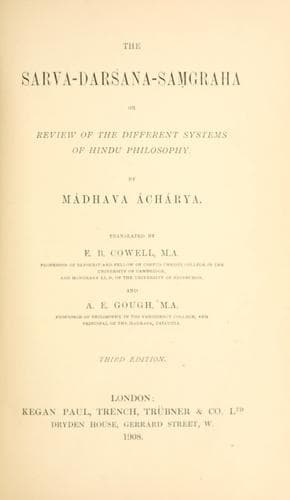
The Sarva-Darsana-Samgraha: Or, Review of the Different Systems of Hindu Philosophy — John Shaqi
The Sarva-Darsana-Samgraha: Or, Review of the Different Systems of Hindu PhilosophyMadhava
ReligionEastern
The Sarva-Darsana-Samgraha: Or, Review of the Different Systems of Hindu Philosophy
Madhava
Philosophy, Hindu; Philosophy, Indic
"A woman attains not the highest knowledge, she enters not Mukti,--so
say the Digambaras; but there is a great division on this point
between them and the Śwetámbaras."[106]
E. B. C.
FOOTNOTES:
[Footnote 40: _Vivasanas_, "without garments."]
[Footnote 41: "The Buddhists are also called _Muktakachchhas_,
alluding to a peculiarity of dress, apparently a habit of wearing the
hem of the lower garment untucked."--_Colebrooke._]
[Footnote 42: In p. 26, line 3, read _Syád-vádinám_.]
[Footnote 43: I propose to read in p. 26, line 5, _infra_, _gráhyasya_
for _agráhyasya_.]
[Footnote 44: As these terms necessarily relate to the perceiver.]
[Footnote 45: I correct the reading _tasyágrahaṇaṃ_ to _tasyá
grahaṇaṃ_ (_tasyá_ being _jaḍatáyáḥ_).]
[Footnote 46: _I.e._, if you say that the _avayava_ may be not seen
though the _avayavin_ is seen, then I may say that the post is the
_avayavin_, and the unperceived three worlds its _avayava_!]
[Footnote 47: I read _arhatsvarúpam arhachchandra_ in p. 27, line 3,
_infra_.]
[Footnote 48: The following passage occurs in some part of Kumárila's
writings in an argument against the Jainas. It is curious that in the
Sáṅkara-digvijaya, chap. lv., it is mentioned that Kumárila had a
little relenting towards the Jainas at the end of his life. He
repented of having so cruelly persecuted them, and acknowledged that
there was some truth in their teaching. _Jainagurumukhát kaśchid
vidyáleśo játaḥ._]
[Footnote 49: Kumárila tries to prove that no such being can exist, as
his existence is not established by any one of the five recognised
proofs,--the sixth, _abháva_, being negative, is, of course, not
applicable. I understand the last śloka as showing the inapplicability
of "presumption" or _arthá-patti_. A Jaina would say, "If the Arhat
were not omniscient, his words would not be true and authoritative,
but we see that they are, therefore he is omniscient." He answers by
retorting that the same argument might be used of Buddha by a
Buddhist; and as the Jaina himself would disallow it in that case, it
cannot be convincing in his own.]
[Footnote 50: In p. 29, line 2, read _tatsadbhávávedakasya_ for
_tatsadbhávádekasya_.]
[Footnote 51: In p. 29, line 9, for _nikhilárthajñanát notpatty_, I
propose to read _nikhilárthajñánotpatty_.]
[Footnote 52: _Janya_ is included in _Kárya_ and equally disputed.]
[Footnote 53: Thus "I am possessed of a body" (_aham Śarírí_), "my
hand," &c., are all sentences in which a predicate involving the
notion of parts is applied to the soul "I."]
[Footnote 54: Reasoning in a circle. I suppose the &c. includes the
_Anavasthádosha_ or reasoning _ad infinitum_. He accepts the supposed
fault, and holds that it is actually borne out in a case before
everybody's eyes.]
[Footnote 55: In p. 31, line 5, _infra_, read _tattvárthe_ for
_tattvártham_.]
Public-domain text, read in full here on John Shaqi.
Reviews
Reviews
No reviews yet
Be the first to share your thoughts on this work.
Join the Discussion
Join the discussion
Sign in to leave a comment or review.
Sign InorCreate an account