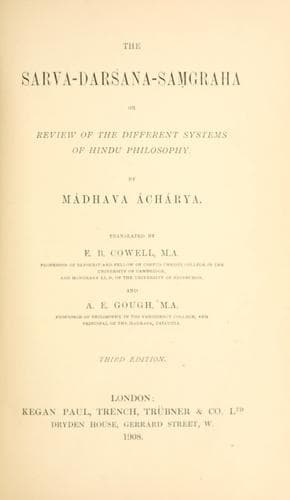
The Sarva-Darsana-Samgraha: Or, Review of the Different Systems of Hindu Philosophy — John Shaqi
The Sarva-Darsana-Samgraha: Or, Review of the Different Systems of Hindu PhilosophyMadhava
ReligionEastern
The Sarva-Darsana-Samgraha: Or, Review of the Different Systems of Hindu Philosophy
Madhava
Philosophy, Hindu; Philosophy, Indic
[Footnote 56: I read in p. 32, line 9, _Samyagdarśanádi_ for
_asamyagdarśanádi_; but the old text may mean "caused by the abolition
of hindrances produced by the qualities, wrong intuition," &c.]
[Footnote 57: Cf. the five _yamas_ in the _Yoga-sútras_, ii. 30.
Hemachandra (_Abhidh_ 81) calls them _yamas_.]
[Footnote 58: I read _kámánám_ for _kámáṇám_ in p. 33, line 7 (2 × 3 × 3 =
18).]
[Footnote 59: For _abháshaṇa_, see Hemach. 16.]
[Footnote 60: I propose in p. 33, line 17,
_raśayanajñánaśraddhávacháraṇáni_ for _rasáyaṇajñanaṃ
śraddhánávaraṇáni_. For _avacháraṇa_, see _Suśruta_, vol. ii. p. 157,
&c. If _anávaraṇa_ be the true reading, I suppose it must mean "the
absence of obstructions."]
[Footnote 61: This is a hard passage, but some light is thrown on it
by the scholiast to Hemachandra, _Abhidh_. 79.]
[Footnote 62: Or this may mean "by the influence of _upaśamakshaya_ or
_kshayopaśama_, it appears characterised by one or the other."]
[Footnote 63: I read in p. 34, line 7, _kalushádyákáreṇa_ for
_kalushányákáreṇa_. The _upaśamakshaya_ and _kshayopaśama_ seem to
correspond to the _aupaśamika_ and _ksháyika_ states about to be
described.]
[Footnote 64: _Strychnos potatorum._]
[Footnote 65: Just as in the Sánkhya philosophy, the soul is not
really bound though it seems to itself to be so.]
[Footnote 66: A valid non-perception is when an object is not seen,
and yet all the usual concurrent causes of vision are present, such as
the eye, light, &c.]
[Footnote 67: I read in p. 35, line 5, _'stíti_ for _sthiti_.]
[Footnote 68: Hence the term here used for "category"--_astikáya_.]
[Footnote 69: These (by Hemach. _Abhidh._ 21), possess only one
sense--touch. In p. 35, line 10, I read _śaṅkhagaṇḍolakaprabhṛitayas
trasáś chaturvidháḥ pṛithivyaptejo_.]
[Footnote 70: In p. 35, line 16, I read _teshám ajívatvát_ for _tesháṃ
jívatvát_. If we keep the old reading we must translate it, "because
the former only are animate."]
[Footnote 71: In p. 35, line 3 from bottom, I read _sarvatrávasthite_ for
_sarvatrávasthiti_. In the preceding line I read _álokenávachchhinne_ for
_álokenávichchhinne_.]
[Footnote 72: Cf. Siddhánta-muktávali, p. 27. The _vishaya_ is
_upabhoga-sádhanam_, but it begins with the _dvyaṇuka_. This category
takes up the forms of _sthávara_ which were excluded from _jíva_.]
[Footnote 73: It is an interesting illustration how thoroughly Mádhava
for the time throws himself into the Jaina system which he is
analysing, when we see that he gives the Jaina terminology for this
definition of _dravya_,--cf. _Vaiśesh. Sútra_, i. 1, 15. _Paryáya_ is
explained as _karman_ in Hemach. _Anek_. _Paryáya_, in p. 36, line 11
(_infra_, p. 53, line 9), seems used in a different sense from that
which it bears elsewhere. I have taken it doubtingly as in Hemach.
_Abhidh_. 1503, _paryáyo 'nukramaḥ kramaḥ_.]
[Footnote 74: _Yoga_ seems to be here the natural impulse of the soul
to act.]
[Footnote 75: In line 18, read _ásravaṇakáraṇatvád_.]
Public-domain text, read in full here on John Shaqi.
Reviews
Reviews
No reviews yet
Be the first to share your thoughts on this work.
Join the Discussion
Join the discussion
Sign in to leave a comment or review.
Sign InorCreate an account