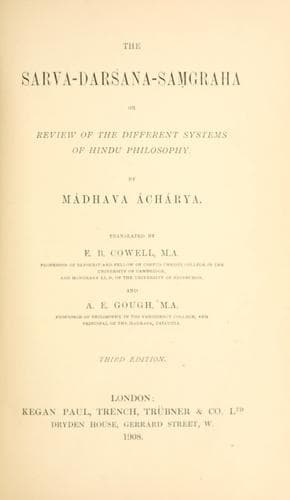
The Sarva-Darsana-Samgraha: Or, Review of the Different Systems of Hindu PhilosophyMadhava
ReligionEastern
The Sarva-Darsana-Samgraha: Or, Review of the Different Systems of Hindu Philosophy
Madhava
Philosophy, Hindu; Philosophy, Indic
The whole is thus to be summed up. Four classes of our opponents
severally hold the doctrine of existence, non-existence, existence and
non-existence successively, and the doctrine that everything is
inexplicable (_anirvachaníyatá_);[97] three other classes hold one or
other of the three first theories combined with the fourth.[98] Now,
when they meet us with the scornful questions, "Does the thing exist?"
&c., we have an answer always possible, "It exists in a certain way,"
&c., and our opponents are all abashed to silence, and victory accrues
to the holder of the _Syád-váda_, which ascertains the entire meaning
of all things. Thus said the teacher in the _Syádváda-mañjarí_--
"A thing of an entirely indeterminate nature is the object only of the
omniscient; a thing partly determined is held to be the true object of
scientific investigation.[99] When our reasonings based on one point
proceed in the revealed way, it is called the revealed _Syád-váda_,
which ascertains the entire meaning of all things."
"All other systems are full of jealousy from their mutual propositions
and counter-propositions; it is only the doctrine of the Arhat which
with no partiality equally favours all sects."
The Jaina doctrine has thus been summed up by Jinadatta-súri--
"The hindrances belonging to vigour, enjoyment, sensual pleasure,
giving and receiving,--sleep, fear, ignorance, aversion, laughter,
liking, disliking, love, hatred, want of indifference, desire, sorrow,
deceit, these are the eighteen 'faults' (_dosha_) according to our
system.[100] The divine Jina is our Guru, who declares the true
knowledge of the _tattwas_. The path[101] of emancipation consists of
knowledge, intuition, and conduct. There are two means of proof
(_pramáṇa_) in the _Syád-váda_ doctrine,--sense-perception and
inference. All consists of the eternal and the non-eternal; there are
nine or seven _tattwas_. The _jíva_, the _ajíva_, merit and demerit,
_ásrava_, _saṃvara_, _bandha_, _nirjará_, _mukti_,--we will now
explain each. _Jíva_ is defined as intelligence; _ajíva_ is all other
than it; merit means bodies which arise from good actions, demerit the
opposite; _ásrava_ is the bondage of actions,[102] _nirjará_ is the
unloosing thereof; _moksha_ arises from the destruction of the eight
forms of _karman_ or "action". But by some teachers "merit" is
included in _saṃvara_,[103] and "demerit" in _ásrava_.
"Of the soul which has attained the four infinite things[104] and is
hidden from the world, and whose eight actions are abolished, absolute
liberation is declared by Jina. The Śwetámbaras are the destroyers of
all defilement, they live by alms,[105] they pluck out their hair,
they practise patience, they avoid all association, and are called the
Jaina _Sádhus_. The Digambaras pluck out their hair, they carry
peacocks' tails in their hands, they drink from their hands, and they
eat upright in the giver's house,--these are the second class of the
Jaina Ṛishis.
Public-domain text, read in full here on John Shaqi.
Reviews
Reviews
No reviews yet
Be the first to share your thoughts on this work.
Join the Discussion
Join the discussion
Sign in to leave a comment or review.
Sign InorCreate an account