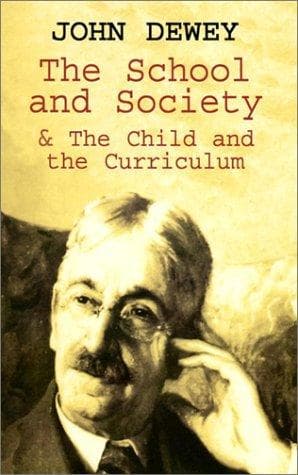
Educational practice has exhibited an unconscious adaptation to and
harmony with the prevailing psychology; both grew out of the same soil.
Just as mind was supposed to get its filling by direct contact with the
world, so all the needs of instruction were thought to be met by bringing
the child mind into direct relation with various bodies of external
fact labeled geography, arithmetic, grammar, etc. That these classified
sets of facts were simply selections from the social life of the past
was overlooked; equally so that they had been generated out of social
situations and represented the answers found for social needs. No social
element was found in the subject-matter nor in the intrinsic appeal which
it made to the child; it was located wholly outside in the teacher—in
the encouragements, admonitions, urgings, and devices of the instructor
in getting the child’s mind to work upon a material which in itself was
only accidentally lighted up by any social gleam. It was forgotten that
the maximum appeal, and the full meaning in the life of the child, could
be secured only when the studies were presented, not as bare external
studies, but from the standpoint of the relation they bear to the life of
society. It was forgotten that to become integral parts of the child’s
conduct and character they must be assimilated, not as mere items of
information, but as organic parts of his present needs and aims—which in
turn are social.
In the second place, the older psychology was a psychology of knowledge,
of intellect. Emotion and endeavor occupied but an incidental and
derivative place. Much was said about sensations—next to nothing about
movements. There was discussion of ideas and of whether they originated
in sensations or in some innate mental faculty; but the possibility of
their origin in and from the needs of action was ignored. Their influence
upon conduct, upon behavior, was regarded as an external attachment. Now
we believe (to use the words of Mr. James) that the intellect, the sphere
of sensations and ideas, is but a “middle department which we sometimes
take to be final, failing to see, amidst the monstrous diversity of the
length and complications of the cogitations which may fill it, that
it can have but one essential function—the function of defining the
direction which our activity, immediate or remote, shall take.”
Public-domain text, read in full here on John Shaqi.
Reviews
Reviews
No reviews yet
Be the first to share your thoughts on this work.
Join the Discussion
Join the discussion
Sign in to leave a comment or review.
Sign InorCreate an account