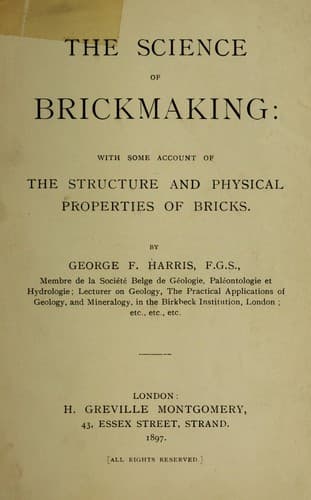
The Science of BrickmakingHarris, George Frederick
Science
The Science of Brickmaking
Harris, George Frederick
Brickmaking -- Handbooks, manuals, etc.
Turning to a smaller matter, the hand-barrow coming from the drying
stacks to the kiln is unprotected, which often means that a good brick
is spoilt. Of course, we are not alluding, in this connexion, to what
takes place during clamp stacking; the brick produced by such a process
must take its chance. The method of stacking in the kiln or clamp is
very often responsible for damage to the bricks. A common method is to
build them sloping outwards, and all sorts of strains and stresses are
thus set up, which have their effect in producing lines of weakness, if
not of actual visible cracks.
The “London stock,” if not a thing of beauty, is usually strong, and
that in spite of the “breeze” which forms so many points from whence
cracks radiate. We must not forget, however, that a really good London
stock is, above all things, thoroughly burnt, and that is a set-off
against the numerous and often wide cracks.
We will assume that the brick has been either naturally or artificially
dried, that no cracks have made their appearance, and that it is
properly stacked in the kiln ready for burning. Now comes a most
important part of the process. It is possible that any microscopic
cracks will be closed by fusion or agglutination; but it more
frequently happens that in unskilled hands the kiln is responsible for
many cracked and “starred” bricks. To know exactly how to introduce
the heat so gradually that the bricks shall not be impaired, is an art
begotten only of considerable experience. Even when dealing with one
particular kind of brick-earth, the maker must be careful to notice
the relative moistness of his charge, and vary the mode of procedure
accordingly. Suppose the brick to be as “dry as a bone” before being
put in the kiln, we shall notice a considerable amount of moisture
coming out of it as soon as the fires are alight; and if the heat
is applied too suddenly, the bricks are not improved--they contract
unevenly and too quickly, and warp. When well alight, care should
be taken to keep the temperature as uniform as possible, and when
sufficiently burnt it must be lowered by almost imperceptible degrees.
Above all things, there should not be too great a disparity between
the temperature in the kiln and the outside air when unloading. Except
to those who had minutely studied this matter, such a precaution might
seem superfluous; it may be that no damage caused will be visible to
the naked eye, but the microscope frequently shows flaws due apparently
to this cause. The manufacturer may test this for himself by heating
a good, sound medium burnt brick to the temperature usually found in
his kiln when unloading, and suddenly plunging it in snow. It is not,
perhaps, that any one of these things is especially dangerous to the
brick, but it is the combined effect of all of them trending in the
same direction. We desire to be clearly understood on this point.
The cracks produced may not seriously impair the strength of the
Public-domain text, read in full here on John Shaqi.
Reviews
Reviews
No reviews yet
Be the first to share your thoughts on this work.
Join the Discussion
Join the discussion
Sign in to leave a comment or review.
Sign InorCreate an account