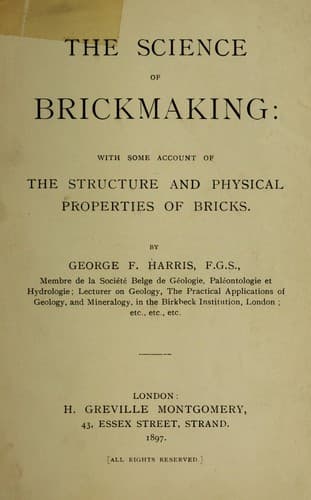
The Science of BrickmakingHarris, George Frederick
Science
The Science of Brickmaking
Harris, George Frederick
Brickmaking -- Handbooks, manuals, etc.
It is not always an easy matter in burning a red brick to obtain two
kilns full of the same tint, even in the same yard. When the employment
of pyrometers becomes more general, that will be considerably
simplified; but it is a difficult matter to get a reliable instrument,
none of the forms hitherto invented being altogether suitable. That by
Professor Roberts-Austen is as good as any. Many manufacturers, we are
sorry to say, place colour before everything else; they even sacrifice
durability to attain a certain tint. And there is much excuse for
them so long as they find a ready sale for the material. When colours
are made from artificially introduced mineral matter (which is not so
often the case as some appear to think) the mineral introduced is,
most commonly, iron; though it will be understood, from what we have
previously said, that it must be used very sparingly.
The ultimate tint assumed by the brick cannot always be judged
beforehand from the colour of the brick-earth. In brickmakers’
language, a red clay is one that produces a red brick, a blue clay
a blue brick, and so on. For the most part, colour depends on the
proportion of hydrated oxide of iron in the clay; if iron is present
in an earth that contains no lime, or similar mineral substance, the
colour produced in the brick at a moderate red heat will be red, and at
the same temperature, with the same brick-earth, the more iron present
the deeper the tint. In an ordinary brick-earth, when more than 10 per
cent. of iron is present, the clay is apt to burn bluish, however, and,
in certain cases, almost black. With a smaller proportion of iron, and
the application of intense heat, the same tint may result, and the
brick become vitrified. A brown colour may frequently be obtained when
the brick-earth has from 2.75 to 4 per cent. of magnesia, or a similar
proportion may be artificially added to the earth.
To obtain a white brick, so that it shall also be of excellent quality,
the pure white clays of Devon and Cornwall are the best, though the
so-called “white” is, in the majority of cases, a light cream colour,
unless, of course, the brick is glazed. In the neighbourhood of
London, a whitish brick results from a mixture of chalk (carbonate
of lime) with clay or loam, and is known as a “malm.” In parts of
Yorkshire, white pressed bricks are manufactured from common red clay
mixed with magnesian lime (made from magnesian limestone) in a slacked
condition. The latter ingredient, on introduction, immediately absorbs
about 40 per cent. of the moisture present in the clay.
Yellow bricks can easily be manufactured from the more impure kaolins;
also from certain clays in Cambridgeshire, Huntingdonshire, Kent, &c.
(gault bricks); “malms” are mostly yellow, though called white.
Public-domain text, read in full here on John Shaqi.
Reviews
Reviews
No reviews yet
Be the first to share your thoughts on this work.
Join the Discussion
Join the discussion
Sign in to leave a comment or review.
Sign InorCreate an account