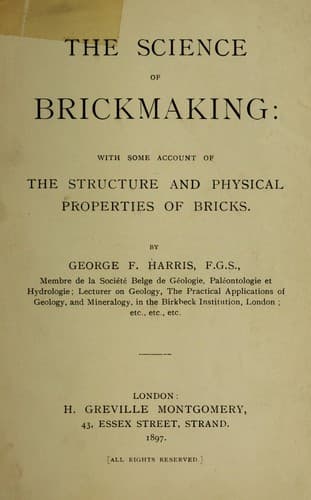
The Science of BrickmakingHarris, George Frederick
Science
The Science of Brickmaking
Harris, George Frederick
Brickmaking -- Handbooks, manuals, etc.
Laboratory experiments, many years old, show that with white clay as
a basis the following tints may be obtained. Phosphates of lime of
various kinds = very light blue bricks. The phosphates, mixed with a
quarter by weight of alum = brighter blue bricks. A mixture of white
vitriol (sulphate of lime) three-quarters, with borax one-quarter =
light dirty green. Sulphur and tin oxide in equal proportions = yellow.
These experiments are interesting, but the ingredients would, as a
rule, be too expensive for ordinary brick manufacture. They are more
applicable for the production of ornamental tiles.
A time-honoured method of producing black bricks is to make any
ordinary bricks red-hot and to dip them in a cauldron of boiling
coal-tar for a few seconds. It is essential that the brick should be
very hot, or the black staining will rub off. A good test that the
operation has been successful is, that the surface shall be dull black,
not shining. And there are many other ways of obtaining different
tints, the description of which would be beyond the scope of the
present work.
Unless a brick is extremely well burnt it is not uniform in colour
throughout. A considerable proportion of a “draw” is often ruined in
regard to tint by the adoption of an unsuitable form of kiln. Where
the brick is actually burned (as distinguished from being baked),
the contact of the flame from the fires is almost sure to lead to
uncertainty in that respect along the flues. Impurities in the coal,
such as iron pyrite, are the chief delinquents, and there is sure to be
a certain amount of “flash.” In that, as well as in the baking method,
bricks are liable to be discoloured by the bringing out of impurities
which they themselves contain.
CHAPTER X.
THE DURABILITY OF BRICKS.
Public-domain text, read in full here on John Shaqi.
Reviews
Reviews
No reviews yet
Be the first to share your thoughts on this work.
Join the Discussion
Join the discussion
Sign in to leave a comment or review.
Sign InorCreate an account