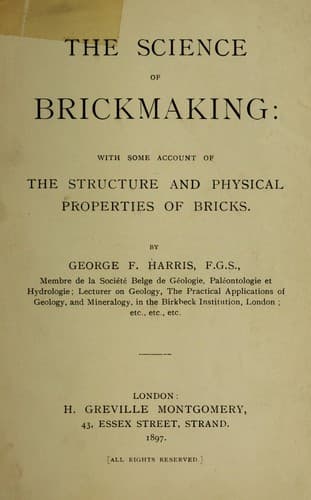
The Science of BrickmakingHarris, George Frederick
Science
The Science of Brickmaking
Harris, George Frederick
Brickmaking -- Handbooks, manuals, etc.
In general, we have to consider whether the brick is strong enough
for the purpose to which it is to be applied; and that depends much
more on the manner in which it is built up, than on the strength of
the individual brick. For ordinary building purposes almost any
kind of brick is, _per se_, strong enough, and a mere inspection of
the specimen suffices to carry conviction as to its suitability or
otherwise in that respect. For certain structures, such as buildings
to carry heavy weights--especially moving weight--for engineering
purposes, and the like, we ought, it is true, to know a little more.
Yet the engineer would be a very poor one who could not tell at sight
whether a brick submitted to him was fit or not for the purpose he has
in view, from the point of view of its weight-carrying properties. In
any case, however, fashion demands the “crushing weight” in figures,
and although such figures are in general of but little practical value,
they must be given.
The principal difficulty the architect and engineer have to contend
with is not lack of strength, but the setting in of decay, and that
even in bricks sometimes of the strongest description. Unless the
strength is going to be maintained, it is of no use whatever, in a
scientific sense, to give it in the first instance.
After these few preliminary observations, it will be well to treat the
subject more systematically.
THE EFFECT OF THE ATMOSPHERE ON BRICKS.
Air is a mixture of gases; dry air consists of at least four of them,
namely, nitrogen, oxygen, carbonic acid, and argon. Of these, by far
the most abundant is nitrogen, present to the extent of about 78 per
cent., then oxygen, 20.96 per cent., argon about 1 per cent., and
carbonic acid 0.04 per cent. Extremely minute quantities of ammonia and
ozone, though practically always present, have been omitted from the
preceding results of analysis of air.
We have been speaking of pure dry air; but the atmosphere is hardly
ever of precisely the same chemical composition in two different
places. By the seaside it has more ozone, and chloride of sodium
is found in particular abundance. In cities, especially where
large factories exist, nitric acid and sulphuric acid appear most
conspicuously, and the proportion of ammonia becomes larger. In the
air of streets and houses, the proportion of oxygen diminishes, whilst
that of carbonic acid increases. Dr. Angus Smith has shown that very
pure air should contain not less than 20.99 per cent. of oxygen, with
0.030 of carbonic acid; but he found impure air in Manchester to have
only 20.21 of oxygen, whilst the proportion of carbonic acid in that
city during fogs was ascertained to rise sometimes to 0.0679, and in
the pit of a theatre to the very large amount of 0.2734. Although these
may seem to be very small percentages, yet the total amount of carbonic
acid in the atmosphere is enormous, and plays a conspicuous part in the
decay of certain kinds of bricks.
Public-domain text, read in full here on John Shaqi.
Reviews
Reviews
No reviews yet
Be the first to share your thoughts on this work.
Elsewhere in the archive
Join the Discussion
Join the discussion
Sign in to leave a comment or review.
Sign InorCreate an account