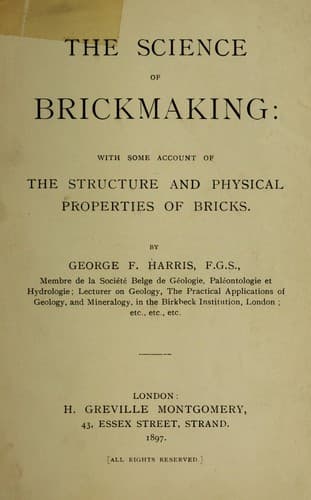
The Science of BrickmakingHarris, George Frederick
Science
The Science of Brickmaking
Harris, George Frederick
Brickmaking -- Handbooks, manuals, etc.
The fragment may be securely clipped and held in position on the
stage, the “bull’s-eye” condenser being brought into use to throw
a strong light on the part immediately under the objective. The
polarising apparatus is no use for this, and may be thrown out of
gear. A very low power should be employed. The observation may be
directed towards ascertaining how far the fragments composing the
brick are agglutinated, and their size may be noted. Anything like a
discolouration should be specially observed, and a minute description
jotted down. In bricks that have not been burnt very hard, and in
those that have merely been baked, we shall often be able to detect
particles of mineral matter which further investigation, after the
manner presently to be described, shows are opaque. Different forms
of iron, iron pyrite, fragments of clay that have merely been dried
in the process of baking, and minute pieces of chalk (now converted
into lime) are amongst the most prominent opaque substances met with
in common bricks. These may generally be differentiated and determined
at sight, and bricks thus composed are never of good quality, though
the ingredients have been ground very fine, and there may be nothing
superficially to find fault with. Their bad qualities are usually
brought out in the weathering. A great deal may, therefore, be learned
from a careful examination of fragments in this manner.
In regard to the examination of very thin slices, that is in the
majority of instances the most instructive, and, if we may say so, the
most interesting method of investigation, though it must always go hand
in hand with the other. The slice of the brick is so thin that the
bulk of the constituents is rendered transparent, or semi-transparent.
The preparation of such slices[15] is not difficult, but demands
some experience; those who have neither the time nor patience to
make them will find it convenient to send the fragments of brick to
Damon, of Weymouth, or some other first-class dealer in geological
and mineralogical specimens. The price charged, per slide, is usually
1s. 6d. At the same time, the student will find it eminently to his
advantage to prepare the slices himself. In the process he will learn
much that escapes attention when the work is done by another.
Public-domain text, read in full here on John Shaqi.
Reviews
Reviews
No reviews yet
Be the first to share your thoughts on this work.
Elsewhere in the archive
Join the Discussion
Join the discussion
Sign in to leave a comment or review.
Sign InorCreate an account