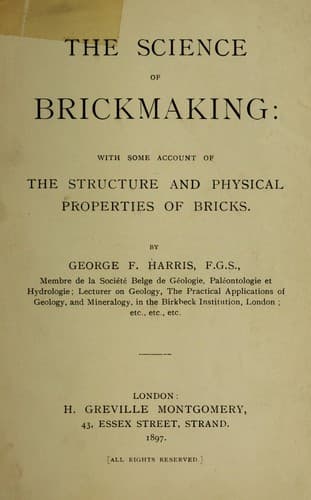
The Science of BrickmakingHarris, George Frederick
Science
The Science of Brickmaking
Harris, George Frederick
Brickmaking -- Handbooks, manuals, etc.
But we must give our attention solely to the strength of bricks. To
begin with, we must deprecate the idea that experiments as at present
carried out give anything like the actual strength of bricks--the
results are generally either too high or too low. Neither are the
results comparative, except to a limited extent. One kind of brick has
a “frog” on one side, another is recessed on both sides, a third is
stamped with the maker’s name, or some device by way of trade mark,
a fourth is as flat on all sides as may be, a fifth is pressed, a
sixth is hand made, and a seventh wire-cut, and there are many other
varieties of make. With such different kinds it is next to impossible
to arrive at comparative data that shall be of much use for working
purposes. Again, the whole brick may be subject to the experiment, or
only the half-brick. The faces placed between the dies of the crushing
machine may not be flat, and they are most frequently irregular. If
the dies are applied to such bricks it is evident that corners will
be broken off before the brick has really suffered much, and that to
get the best result the faces must either be made perfectly true and
parallel to each other, or some other method adopted to put matters
right. That commonly employed is to place some yielding substance
between the faces and the surface of the dies. Sometimes thin sheets
of lead or pine wood are inserted. Professor Unwin has the faces of
the brick made smooth and parallel by means of plaster of Paris, and
the brick is then crushed between two pieces of millboard or between
the iron pressure-plates, one plate having an arrangement to allow for
any slight want of parallelism between the two surfaces of the brick
applied to the plates.
Public-domain text, read in full here on John Shaqi.
Reviews
Reviews
No reviews yet
Be the first to share your thoughts on this work.
Elsewhere in the archive
Join the Discussion
Join the discussion
Sign in to leave a comment or review.
Sign InorCreate an account