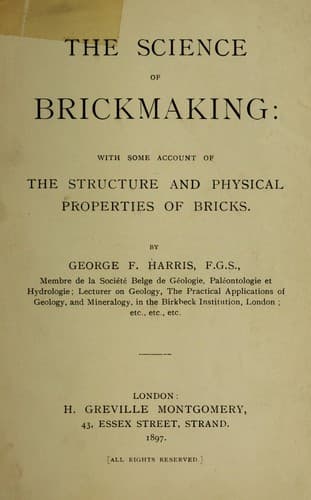
The Science of BrickmakingHarris, George Frederick
Science
The Science of Brickmaking
Harris, George Frederick
Brickmaking -- Handbooks, manuals, etc.
Glazed brick |8.8 × 4.4 × 3.3 | 69 | 166 | -- |Frog.
„ „ |8.9 × 4.4 × 2.9 | 166 | 174 | -- |
---------------+----------------+-----------+----------+--------+------------
Table No. III. is specially instructive as indicating the relative
strength of several well-known bricks, the experiments being carried
out solely for scientific purposes. Yet the figures must not be taken
too seriously. Glancing at those relating to “London Stocks,” we find
the strength varied from 103 tons per square foot to 181 tons. But
more recent experiments made by Professor Unwin[19] on some London
Stocks from Sittingbourne, in Kent, shewed that with four samples one
crushed at 60.76 tons per square foot and another gave out 94.6 tons,
the mean strength of the four yielding 84.27 tons per square foot.
With such heterogeneous materials as London Stocks, we ought not to be
surprised at these results, but they form a striking commentary on the
value of general statements concerning the strength of bricks of varied
character going by the same name in the market.
When we consider the strength of homogeneous bricks, and especially
where these latter are made of thick marine clays, or where the
relative proportions of earths employed are carefully attended
to in the raw material, the results appear to be more generally
applicable--as far as they go.
With ordinary Gault bricks we find a range in strength from 145 tons to
173 tons per square foot; but Professor Unwin,[20] in his more recent
experiments, finds that of four Gault bricks, one reached as high as
197.6 tons per square foot, and he gives 182.2 tons as the average
strength.
To shew the absurdity of alluding to the strength of “blue
Staffordshire” bricks, without also giving the precise locale of the
samples dealt with, the reader is requested to refer to Table III.,
where the figures indicate a range from 275 tons to 464 tons per square
foot, and to compare them with the results on Staffordshire bricks as
stated in Table II., where we find a range from 651 tons to 1,064.2
tons per square foot. Of what value can a single formula be which gives
the strength of Staffordshire bricks as a whole as based on such widely
divergent figures as these? Professor Unwin, in his recent series of
experiments alluded to, finds that with four Staffordshire blue bricks,
the weakest gave a result of 564.8 tons per square foot, and the
strongest 788 tons; the mean of the four being 701.1 tons per square
foot.
The results on the Leicester “reds” are no more encouraging; the
figures in the foregoing tables are 150.6 tons, 229 tons, 308 tons, and
337 tons per square foot. Similarly, Professor Unwin has more recently
found that the Leicester “reds” from Elliston, near Leicester, bear a
crushing strain varying from 311.4 tons to 591.4 tons per square foot
in four samples.
Public-domain text, read in full here on John Shaqi.
Reviews
Reviews
No reviews yet
Be the first to share your thoughts on this work.
Elsewhere in the archive
Join the Discussion
Join the discussion
Sign in to leave a comment or review.
Sign InorCreate an account