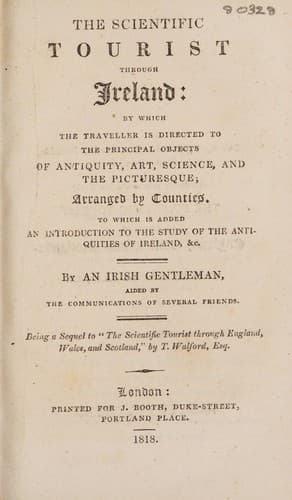
The Scientific Tourist through Ireland: in which the traveller is directed to the principal objects of antiquity, art, science & the picturesqueWalford, Thomas
History
The Scientific Tourist through Ireland: in which the traveller is directed to the principal objects of antiquity, art, science & the picturesque
Walford, Thomas
Ireland -- Description and travel
THOMASTOWN, 9 m. S.E. from Kilkenny, deserves the notice of the
antiquary from its being one of the most ancient towns in the
island, being founded by one of the chiefs of Henry II. in his first
expedition. From this Thomas Fitz-Anthony it derives its nomenclature.
Its principal remnant of antiquity is the Abbey, of which there are
some considerable fragments; one end being fitted up as the parish
Ch. There is a venerable Tower at one angle; and the Gothic arcades
afford some fine specimens of the lancet arch, evidently of a date
posterior to the foundation of the town itself. In the ruinous part of
the edifice, the tourist will notice a large sepulchral stone, which
is reported in traditionary legends to cover the body of a giant.
Its trade is considerably increasing in consequence of the river
navigation. The river Argula falls into the Nore, close by Ballyduff,
where are ruins of an old Castle. About 2 m. above it, on the banks
of the Nore, are the ruins of the Abbey of Jerpoint, a Cistertian
establishment as early as 1180. Its remains, which are extensive, more
resemble a fortress than an Abbey; and it has a very fine light and
airy Tower with four pinnacles. The picturesque tourist when at this
place must not omit a most romantic walk to a secluded dell and glen
at Kilfaun, about 1-1/2 m. in length, well described by Wakefield, who
notices an elegant cottage placed in a situation truly delightful;
opposite to which is a waterfall, the rivulet running through the lawn
and flower garden, having on both sides rocks ornamented with large
evergreens, the whole scene exhibiting numerous beauties both of art
and nature. Near Thomastown is Mount Juliet, the seat of the Earl
of Carrick, which, though in a neglected state as described by Mr.
Wakefield, is deserving of notice; the house being built in the old
fashioned style of architecture, and standing immediately on the banks
of the romantic and rapid Nore.
MINERALOGY.
Granite in various parts of the county; particularly on Brandon
mountain near Gowran, with siliceous schistus, containing mica,
crystals, and jasper. Pyrites and quartz near Inistioge. Black slate
and hone-stones near Castle Durrow. Kilkenny coal near Castle Comer.
Some pieces of very fine compact jasper, of various sizes, may be found
on the borders of the granite district in the S. The specimens already
discovered were of a deep red colour, for the most part obtusely
angular, and squarer at one end than the other: they were imbedded in
yellow clay, a few feet below the surface.
The mineralogist may feel gratified by the examination of a very fine
granite quarry in the vicinity of Gowran. It is a beautiful stone of
a light yellow cast, fine grained and compact, and may be taken up in
blocks of any required size.
Public-domain text, read in full here on John Shaqi.
Reviews
Reviews
No reviews yet
Be the first to share your thoughts on this work.
Elsewhere in the archive
Join the Discussion
Join the discussion
Sign in to leave a comment or review.
Sign InorCreate an account