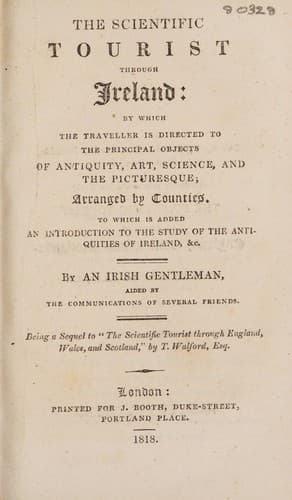
The Scientific Tourist through Ireland: in which the traveller is directed to the principal objects of antiquity, art, science & the picturesqueWalford, Thomas
History
The Scientific Tourist through Ireland: in which the traveller is directed to the principal objects of antiquity, art, science & the picturesque
Walford, Thomas
Ireland -- Description and travel
PHILIPSTOWN, 39 m. S.W. from Dublin, took its name from Philip of
Spain, being in a new shire incorporated by Queen Mary.--See ruins of
Castle on bank of the river, with the spacious Gaol,--this, though
a sorry village, being the county town. Near it see Croghan-hill,
conical, and beautifully clothed with the most luxuriant verdure to
its top; with ruins of Ch. at the base, and ancient cemetery at the
summit.
PORTARLINGTON, 10 m. S.E., stands partly in this county, partly in
Queen's, being divided by the river Barrow.
TULLAMORE, 7 m. S.W. of Philipstown, is divided in two by the river
Clodagh. Here the tourist will find a good inn and accommodations
at the Charleville Arms near the bridge. The town was burnt down a
few years ago, but is reviving rapidly, with a busy and flourishing
aspect, under the auspices of Lord Charleville; intersected by a canal
leading from Dublin to the Shannon, on which a covered boat is fitted
for passengers. A short distance, and on the banks of the canal, see
a small square fortress in good preservation. See Charleville Castle,
a magnificent mansion in all respects, erected in the Gothic style,
but yet wanting the hoary hand of time to darken its castellated
battlements, being built of limestone, which does not yet harmonize
with the foliage of a flat park, or with the artificial piece of water
formed in its front. The scenery in the demesne is very fine, with
cascades, grottoes, rustic bridges, &c., &c. Clara, 10 m. W., is a
neat handsome village, surrounded by the Linen Manufactory. Geashill,
3 m. S.E., has ruins of an ancient lofty Castle, the residence of the
O'Molloys, which, defended by a lady, made a strong resistance against
Cromwell. Near it a celebrated spring, and ruins of an Abbey.
MINERALS.
The Sliebh-bloom mountains offer a fine field of research to the
mineralogical and geological tourist; being at present virgin ground.
In other parts may be found, manganese, iron ore, ochres, with
limestone and potter's clay.
BOTANY.
_Hypnum crispum_, Curled Hypnum:--in woods, heaths, and rocks.
_Melittis Melissophyllum_, Bastard Balm:--in woods and hedges.
_Pinus sylvestris_, Scotch Fir:--in woods in various parts.
_Pyrola rotundifolia_, Wintergreen:--in a bog near Dunkerrin.
LEITRIM
Borders on the sea at its N.W. extremity; almost entirely covered
by groups of mountains, not completely barren, affording sufficient
herbage for the feeding of cattle; whilst the vales between them are
occupied by numerous lakes giving rise to equally numerous rivers. The
picturesque tourist will here behold nature in her boldest features;
and the antiquary may gratify himself with the examination of numerous
ancient Castles in situations of the wildest and most savage grandeur.
The lakes are numerous. Bounded on the S. by Roscommon and Sligo; W. by
Bay of Donnegal; N. by Donnegal and Fermanagh; E. and S.E. by Cavan and
Longford.
Public-domain text, read in full here on John Shaqi.
Reviews
Reviews
No reviews yet
Be the first to share your thoughts on this work.
Elsewhere in the archive
Join the Discussion
Join the discussion
Sign in to leave a comment or review.
Sign InorCreate an account