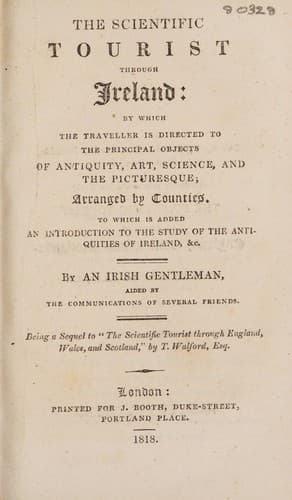
The Scientific Tourist through Ireland: in which the traveller is directed to the principal objects of antiquity, art, science & the picturesqueWalford, Thomas
History
The Scientific Tourist through Ireland: in which the traveller is directed to the principal objects of antiquity, art, science & the picturesque
Walford, Thomas
Ireland -- Description and travel
LONDONDERRY is a city 115 m. N.W. of Dublin, about 1 m. in
circumference, which the tourist will visit with interest, on account
of its well known siege in 1690. Walk round the walls; see the
Cathedral, of some antiquity (1633), the wooden bridge, 1/3 of a m.
in length over a branch of Loch-Foyle, serving also as an aqueduct.
Town-hall and Market-house; the Episcopal Palace, with the gardens
outside of the walls, from whence there is a fine prospect. The view
of the city from the bridge, with the shipping, and backed by lofty
hills, is worthy of notice. The view of this town at the distance of a
mile or two is most picturesque, seeming to be built on an island
of bold land rising from the river, and backed by extensive hills.
The philanthropic tourist will not fail to visit the Infirmary, a
handsome spacious edifice under good regulations; also the Repository
for Work, and the Institution for small loans to the industrious
poor. (See Curwen, vol. i. p. 232, for rules and regulations.) Good
accommodations and post-horses. At 3 m. N., see Aileach Neid, an
ancient rath or castle of the O'Neils, constructed like the Danish
forts, and destroyed by Murtogh O'Brian in 1101. Clady is a small
village pleasantly seated on the river Faughan, with ruins of O'Cane's
Castle near it. Lough Foyle is a fine expanse of water, 14 m. by 8,
and forms a most commodious harbour.
KILREA, 26 m. N.E. of Derry, on the borders of Antrim; stands
pleasantly on the river Bann, and is a very cheerful little town,
surrounded by opulence and industry from the linen manufacture.
MAGHERAFELT, 30 m. E. of Derry, is a very neat village, and forms a
good station for the eastern district, and for Lough-Neagh. Maghera is
a small village, in an agreeable neighbourhood. The tract of land on
this side of Carntogher Mountains, called the Braeface, exhibits some
delightful scenery. The cottages are built in tufts of hawthorn-trees,
the humble but happy abodes of an industrious peasantry; deep glens,
lined with bushes and shrubs, winding from the higher parts of the
mountain, mark the progress of the winter floods, and terminate in the
Moyola which runs below. The Danish forts or raths are numerous; and
there is some curious antique sculpture over the church door.
Public-domain text, read in full here on John Shaqi.
Reviews
Reviews
No reviews yet
Be the first to share your thoughts on this work.
Elsewhere in the archive
Join the Discussion
Join the discussion
Sign in to leave a comment or review.
Sign InorCreate an account