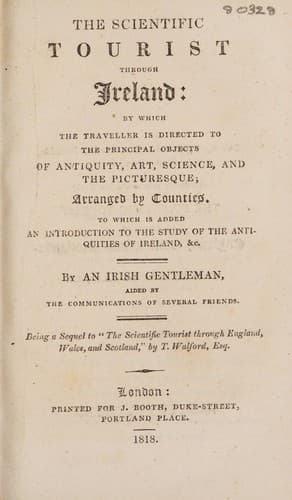
The Scientific Tourist through Ireland: in which the traveller is directed to the principal objects of antiquity, art, science & the picturesqueWalford, Thomas
History
The Scientific Tourist through Ireland: in which the traveller is directed to the principal objects of antiquity, art, science & the picturesque
Walford, Thomas
Ireland -- Description and travel
_Ranunculus Flammula_, Crowfoot:--in wet meadows.
_Saponaria officinalis_, Soapwort:--in dry ditches, but rare.
_Tanacetum vulgare_, Yellow Tansey:--in the river Roe, and sandy
ditches in Drumbane.
_Trifolium alpestre_, Long-leaved Trefoil:--amongst the romantic fallen
rocks of Bengevenogh.
_Veronica maritima_, Sea Speedwell:--several varieties on the coast.
_Viola odorata_, Sweet Violet:--under hedges, bushes, &c.
_Zostera marina_, Grass-wrack:--on shallow beaches.
LONGFORD.
One of the smallest counties. A great proportion is a rude bog, denuded
of timber, and with scarcely a seat of any consequence to attract
the notice of the traveller: yet it is an object of attention to the
statist, as he will here perceive the rapid effects of industry from
the linen manufacture. Bounded W. by Roscommon, N. by Leitrim and
Cavan, E. and S. by Westmeath.
ARDAGH, 5 m. S.E. of Longford.--See some slight remains of the
Cathedral. Abbey Shrule has some ruins of a Convent of Cistertians,
near which Tenelick, the handsome house and extensive demesne of the
late Lord Annaly.
BALLIMAHON, 9 m. S. of Longford, is a small but neat town, standing on
the river Inny, in the southern district, surrounded by some pleasing
scenery.
COLEHILL, 10 m. S.E. of Longford, may be taken as the station for
visiting Abbey Shrule, &c. Near it see Tashiny Church, and ruins of an
old Castle.
EDGWORTHSTOWN, 6 m. S.E. of Longford, is a considerable and improving
village, enlivened by the residence of the literary family from
whom it takes its name. Those who have derived pleasure from the
productions of Miss Edgworth, may receive much amusement from
particulars respecting that family in _Hall's Tour_, vol. ii. p. 15
et seq. See handsome Ch., and spire of cast iron. In the vicinity are
extensive slate quarries. See _Curwen_, ii. 212.
GRANARD, 9 m. E. of Longford, is a neat town, consisting of one
handsome street about half a mile long, at the head of which stands
the Castle, built on a singular hill rising to a considerable
height. It is called the Moat of Granard, and by some supposed to
be artificial. The prospect from the summit extends into several
counties. Near it ruins of Larna Abbey, founded by St. Patrick. The
country round, bleak and mountainous. Lough-Shelon, in the vicinity,
is 7 miles in length, and 4 broad. The artist may here select some
wild scenery. In Lough-Garon; see some remains of an Abbey on an
island; and another once noble edifice in another island--the Abbey of
All Saints; and in the northern vicinity are the Lakes of Dernick and
Earne, highly interesting to the picturesque tourist. The surrender
of the invading French army and of the misguided rebels, to Lord
Cornwallis in 1798, took place at Ballynamuck, a small village not far
distant from Granard.
Public-domain text, read in full here on John Shaqi.
Reviews
Reviews
No reviews yet
Be the first to share your thoughts on this work.
Elsewhere in the archive
Join the Discussion
Join the discussion
Sign in to leave a comment or review.
Sign InorCreate an account