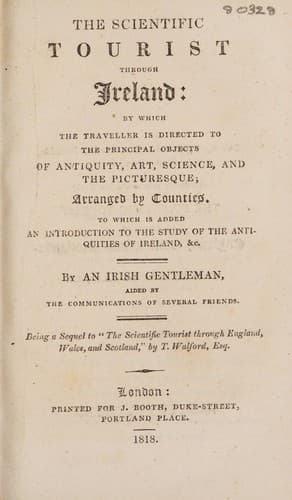
The Scientific Tourist through Ireland: in which the traveller is directed to the principal objects of antiquity, art, science & the picturesqueWalford, Thomas
History
The Scientific Tourist through Ireland: in which the traveller is directed to the principal objects of antiquity, art, science & the picturesque
Walford, Thomas
Ireland -- Description and travel
BALLINROBE, 11 m. S. of Castlebar, a well-built town. See Charter
School and ruins of Abbey; ancient Castle, now Horse Barracks; the
inn clean and comfortable. At Ballaghadireen, wild and romantic
scenery; ancient Castle in ruins. Ballyhannys, 16 m. N.E. has ruins
of venerable Abbey. Cong, now an inconsiderable village, was once the
capital of the Kings of Connaught; and stands in a romantic situation
between the Loughs Corrib and Mask. It contains some ruins of an
Abbey, which, in consequence of its arches being partly semicircular
and partly Gothic or pointed, is supposed to be as early as the 12th
century. Long celebrated for its sanctity, it became for ages the
sepulchral depôt of the powerful and the holy, the chieftain and
the priest, whose dust lies mingled with its sombre yet majestic
ruins. Near it a broad river rushes at once from beneath a sloping
bank, and after a rapid course loses itself in the Lough. This is
supposed to be the outlet of a subterraneous channel, through which
the superfluous waters of Lough Mask are discharged. The scenery
around is most romantic. Hollymount, 6 m. N.E., has a neat Ch.; also
Newbrook House, seat of Lord Clanmorris. Lough Carra, 3 m. N., has
some wild scenery, especially a tract of rocky ground, at a distance
like an immense sheet of white stone, deserving mineralogical notice.
Lough Mask offers some good scenery:--inquire for the gillaroo trout
with gizzards like a fowl. Neal village, 3 m. S., with magnificent
mansion of Lord Kilmaine. About 16 m. N.E., visit the Abbey of Urlare
in a wild, romantic, secluded district. The walls are still entire,
and were never very lofty; the eastern window is very fine, with the
remains of an altar beneath it. It was anciently a place of great
sanctity; and the sepulchral depository of the surrounding chieftains.
Archdall states, from tradition, that a town once existed in its
vicinity.
Public-domain text, read in full here on John Shaqi.
Reviews
Reviews
No reviews yet
Be the first to share your thoughts on this work.
Elsewhere in the archive
Join the Discussion
Join the discussion
Sign in to leave a comment or review.
Sign InorCreate an account