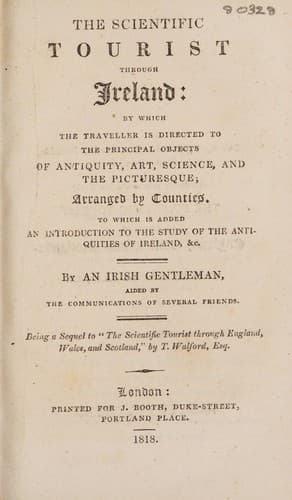
The Scientific Tourist through Ireland: in which the traveller is directed to the principal objects of antiquity, art, science & the picturesqueWalford, Thomas
History
The Scientific Tourist through Ireland: in which the traveller is directed to the principal objects of antiquity, art, science & the picturesque
Walford, Thomas
Ireland -- Description and travel
ROSCREA, 30 m. N. of Clonmell, stands on the very verge of the
county, and is a thriving and wealthy town, on the post road from
Dublin to Limerick, standing in a fertile and populous district. At
the entrance of the town the tourist will notice the very curious
architectural decorations of the Ch., with its Saxon doors and niches,
its sepulchral crosses; and lofty round tower, 80 feet in height and
15 feet in diameter, possessing also the singularity of a window with
a pointed arch at the height of 30 feet from the ground. The Castle
(1213) is now a barrack. Monaincha, about 3 m. from Roscrea, and
about 1 m. S. from the road leading to Burros in Ossory, cannot fail
to be highly interesting to the antiquary as the birth-place of the
long celebrated monastic order of the Culdees, a Christian but not
Roman Catholic sect, that commenced in the 6th century, according to
Ledwich, in this remote corner of the world, in a little island in
the midst of a bog, sometimes called Innisnabeo, or the "Island of
the living." Columba was their founder, as may be seen at large in
_Ledwich's Antiquities of Ireland_, p. 56; and it is a curious fact
at the present moment, that so adverse were the Culdees to the tenets
and practice of the Church of Rome, as to draw down the wrath of the
Vatican, and the festival of St. Columba was forbidden in the other
parts of Ireland. The bog in which these ruins are now to be seen
was formerly a lake: for Giraldus Cambrensis describes it as such in
1185, with two islands, one containing a Ch. and the other a Chapel;
a fact that must render a visit interesting to the geologist. The
geologist who directs his research to the bog of Allen will naturally
visit this bog of Monela, which is but a continuation of it; and here
he will not fail to notice the extraordinary fact, that what was the
lesser is now become the greater isle. The easternmost of the two is
the largest, and contains about 2 acres; in it stands the Culdean
Abbey, of which considerable vestiges still remain. The tourist will
particularly observe the arch of the choir, which is semicircular or
Saxon, and on which sculpture seems to have exhausted her treasures:
a nebule moulding adorns the outward semicircle of the portal, a
double nebule with beads the second, a chevron the third, interspersed
with the triangular frette, roses and other ornaments. It is also
decorated with chalices, artfully made at every section of the stone,
so as to conceal the joints. Here the ruins afford some research for
the mineralogist, as part of the stones used are of a whitish grit,
brought from the neighbouring hills of Ballaghmore, but being porous
they have suffered much from the weather; whilst the columns of the
choir are of a harder texture, close-grained, reddish in colour, and
once highly polished. These have evidently been quarried on the S.W.
side of the bog, and are a species of schistus, splitting into laminæ
Public-domain text, read in full here on John Shaqi.
Reviews
Reviews
No reviews yet
Be the first to share your thoughts on this work.
Elsewhere in the archive
Join the Discussion
Join the discussion
Sign in to leave a comment or review.
Sign InorCreate an account