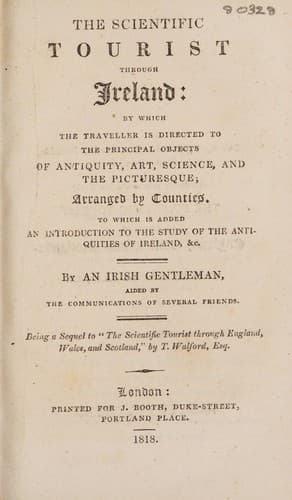
The Scientific Tourist through Ireland: in which the traveller is directed to the principal objects of antiquity, art, science & the picturesqueWalford, Thomas
History
The Scientific Tourist through Ireland: in which the traveller is directed to the principal objects of antiquity, art, science & the picturesque
Walford, Thomas
Ireland -- Description and travel
DUNGARVON, 21 m. S.W. of Waterford, is one of the greatest
fishing-towns in Ireland, being situated near the Nymph Bank; but
Mr. Curwen complains heavily of the bad accommodations which he met
with: the town small; the streets narrow: yet persons returning from
the lakes will do well to take this place in their route. Crossing
the Ferry at Youghall, and passing through an uncultivated tract of
mountain scenery, destitute of inhabitants, but highly susceptible of
improvement, the tourist approaches this town, built on the beach,
and appearing, from the descent of the mountain, as if it stood in
the sea. Dungarvon itself will not detain him long. See Barrack on
site of an ancient Castle; also ruins of Augustine Abbey of Gothic
architecture; lofty steeple springing from a curious vault; ancient
monument (1400). In the summer much company will be met with as a
bathing-place. If the tourist is hurried, and without time to examine
the whole county, he may take an interesting ride across it towards
Clonmell. Leave Dungarvon, cross a valley of excellent land about 4
m. wide; turn round a projecting chain of mountains, and then see
the small village of Kilmacthomas, from which village the first few
miles exhibit the same face of country, till within a short distance
of the banks of the Suir, where the eye is once more gratified with
the appearance of trees. On the right, for nearly the whole of the
way, there are magnificent views of the ocean, but not a gentleman's
seat is to be seen in the whole distance between Youghall and Lord
Waterford's seat at Curraghmore. Ardmore, 8 m. S.W. of Dungarvon,
stands near the sea; a poor village, once episcopal. Examine ruins
of two Ch. with curious sculpture; round tower, 100 feet high, 15 in
diameter; St. Declan's dormitory in cemetery; St. Declan's stone,
that swam from Rome to bring home his belt and vestments: Danish
Raths. Dromana, the splendid mansion and demesne of Lord Grandison
Duck's-pool, 1 m., ruins of Abbey. Kilmacthomas, 9 m. N.E., pleasing
village, with good river scenery and fishing, and some remains of
Castle. Whitchurch, 5 m. W., has curious cave called Con-a-glour, or
the Pigeon-hole, 150 feet long, with subterraneous river, fantastical
crystallizations, &c., from whence (or Lismore) the tourist may visit
Oonamort.
Public-domain text, read in full here on John Shaqi.
Reviews
Reviews
No reviews yet
Be the first to share your thoughts on this work.
Elsewhere in the archive
Join the Discussion
Join the discussion
Sign in to leave a comment or review.
Sign InorCreate an account