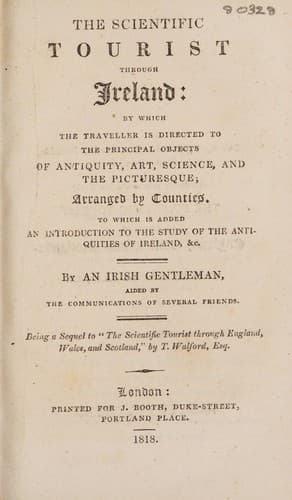
The Scientific Tourist through Ireland: in which the traveller is directed to the principal objects of antiquity, art, science & the picturesqueWalford, Thomas
History
The Scientific Tourist through Ireland: in which the traveller is directed to the principal objects of antiquity, art, science & the picturesque
Walford, Thomas
Ireland -- Description and travel
CASTLETOWN DELVIN, 12 m. N.E. of Mullingar, is a small village, but
a good station for several objects in its district. Near it is the
ancient baronial seat of the Earls of Westmeath; of which a part is
standing, consisting of an oblong square, with a lofty circular tower
at each corner. Near it is a large Danish rath. See, in its vicinity,
Baronston, the seat of Lord Sunderlin, a magnificent mansion,
including the wings, 300 feet in front, seated in the midst of a
considerable park, embosomed in excellent plantations, and surrounded
by a charming country, richly diversified with lakes, hills, and
mountain scenery. Clonmellon has an elegant Ch., with a steeple and
spire, of modern erection, but in imitation of the Gothic. See small
lakes to the N.W.
FORE, 9 m. N. of Mullingar, deserves a visit on account of Lough Lane
in its immediate vicinity. See the ruined Ch. of Clonarney, and that
of Archerstown, near a new-built seat of Mr. Battersby; also a seat
of Mr. Smith. Between Archerstown and Fore, Sir R. C. Hoare notices
a tumulus which appears to be sepulchral, surrounded by a fosse, but
not so exactly executed as those on Salisbury Plain. But Fore also
interests by its own ruins of parish churches, walls, and gateways,
with the shell of a spacious Monastery seated in the vale below,
dedicated to St. Fechin, first built in 630, and re-founded in 1209.
Sir R. G. Hoare states that this Monastery presents a large pile of
simple and unornamented masonry; the Chapel is still in a tolerable
state of preservation, and has three narrow pointed windows. Lough
Lane (already mentioned) a large piece of water with three wooded
islands upon it: it produces good trout and pike. The scenery is not
very romantic, for the banks are flat, but well cultivated. On its N.
side the waters penetrate under the rock, and reappear on the opposite
side of a hill near Fore, where they turn a mill. To the S. of the
lake, at a short distance, is a raised earthen work, commonly called
the "Fort of Turgesius," a chieftain of great military renown with
the old historians. He lived in the ninth century. If any reliance
can be placed upon topographical derivations, this vicinity must
once have had a very literary character; for _Foure_ signifies the
_town of books_, and _Lough Lane_, the _lake of learning_! This lake
gives birth to two rivulets, which discharge themselves into the sea
on opposite sides of the island. There are fine rides through the
well cultivated country in its vicinity, especially in the road to
Rochford, commanding in succession a view of a pleasing lake, Lough
Derrin; the "Crooked Wood," a hill so distinguished for its foliage,
though now denuded; and the beautiful wooded hill of Knockdrin. See
Castle Pollard, and Pakenham Hall; also Loughs Armagh and Drin.
Public-domain text, read in full here on John Shaqi.
Reviews
Reviews
No reviews yet
Be the first to share your thoughts on this work.
Elsewhere in the archive
Join the Discussion
Join the discussion
Sign in to leave a comment or review.
Sign InorCreate an account