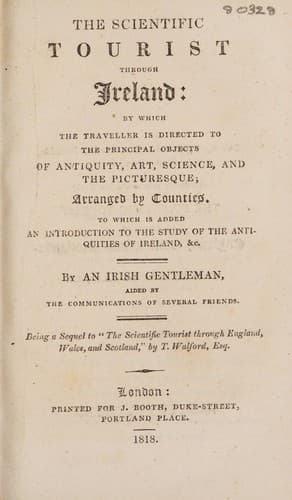
The Scientific Tourist through Ireland: in which the traveller is directed to the principal objects of antiquity, art, science & the picturesqueWalford, Thomas
History
The Scientific Tourist through Ireland: in which the traveller is directed to the principal objects of antiquity, art, science & the picturesque
Walford, Thomas
Ireland -- Description and travel
height throws a gloom on the deep dell below, well suited to inspire
religious dread and horror: for, being covered with brown heath, or
more sable peat, their summits reflect no light whatever. As nothing
facilitates the observation of the tourist more readily than a clear
idea of the topography of the place he visits, it may now be stated to
him, that on entering the vale, he will perceive towards the S. the
mountains Lugduff and Derrybaun, separated only by a small cataract,
opposite to which, and on the other side of the lake, is Kemyderry,
between which and Broccagh on the north side is a road leading from
Hollywood to Wicklow. At the west end of the upper lake he will
observe a cascade called Glaneola Brook, falling from the hill; and
further on St. Kevin's Keeve, a small stream from Glendason river, and
in which Superstition still dips weak and sickly children every Sunday
and Thursday before sunrise,--and certainly with an efficacy which an
early cold bath must produce on any other day of the week. Looking
into the bosom of the vale, the tourist will soon perceive that these
and other cataracts form a junction when they assume the name of
Avonmore or the Great River, sometimes so swelled with torrents as
to be rapid and dangerous, but generally confined within narrower
bounds, and merely feeding two romantic little lakes separated from
each other by a rich and verdant meadow. It is evident from the names
of the mountains, that these eminences were once a forest; but at
present the gloom of foliage is much wanted by the venerable ruins
of the religious edifices, or the "Seven Churches" that give so much
interest to the vale. Here once stood an extensive city, but now
almost extinct, except that from what can now be discovered by its
walls and foundations, it is conceived to have extended from the
"Refeart Church" to the "Ivy Church," on both sides of the river; and
some idea of its ancient state may be formed from its remains in the
road leading from the market-place into the county of Kildare, still
in good preservation, being paved with stones placed edgewise, to the
breadth of ten feet. Those who wish to know all the superstitious
traditions respecting this holy spot, may consult the second article
in _Ledwich's Antiquities of Ireland_, where they are related. One of
these, however, must be noticed, as explanatory of one of the wonders
of the place. Tradition tells, and Superstition believes, that St.
Kevin, whilst ascending a neighbouring hill in a period of scarcity
and famine, met a woman with a sack on her head, in which were five
loaves. The woman, being rather churlish, when the saint inquired the
contents of her sack, told him they were stones. "I pray they may be
so," said the holy inquirer, when instantly five stones tumbled out,
rolled towards Refeart Ch. where they were kept as sacred reliques
for many years, but are now exhibited in the valley, weighing about
Public-domain text, read in full here on John Shaqi.
Reviews
Reviews
No reviews yet
Be the first to share your thoughts on this work.
Elsewhere in the archive
Join the Discussion
Join the discussion
Sign in to leave a comment or review.
Sign InorCreate an account