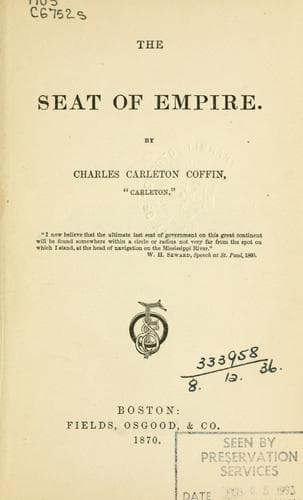
Minnesota -- Description and travel; Northwest, Canadian; Northwestern States; Red River of the North
The Suez Canal, the construction of a large harbor on the sand-beach of
the Mediterranean, and another of equal capacity on the Red Sea, is one
of the wonders of modern times,--a triumph of engineering skill and of
the indomitable will of one energetic man.
The people of Duluth will not be under the necessity of manufacturing
the material for the breakwater, for along the northern shore there
is an abundant supply of granite which can be easily quarried. It is
proposed to make an inner harbor by digging a canal across Minnesota
Point and excavating the shallows.
The difficulties to be overcome at Duluth bear slight comparison with
those already surmounted on the Mediterranean. The commercial men of
Chicago contemplate the fencing in of a few hundred acres of Lake
Michigan; and there is no reason to doubt that a like thing can be done
at the western end of Lake Superior.
Two years ago Duluth was a forest; but in this month of May, 1870,
it has two thousand inhabitants, with the prospect of doubling its
population within a twelvemonth. The woodman's axe is ringing on the
hills, and the trees are falling beneath his sturdy strokes. From
morning till night we hear the joiner's plane and the click of the
mason's trowel. You may find excellent accommodation in a large hotel,
erected at a cost of forty thousand dollars. We may purchase the
products of all climes in the stores,--sugar from the West Indies,
coffee from Java, tea from China, or silks from the looms of France.
The printing-press is here issuing the Duluth Minnesotian, a sprightly
sheet that looks sharply after the interests of this growing town.
Musical as the ripples upon the pebbly shore of the lake are the voices
of the children reciting their lessons in yonder school-house. I am
borne back to boyhood days,--to the old school-house, with its hard
benches, where I studied, played, caught flies, was cheated swapping
jack-knives, and got a licking besides! Glorious days they were for all
that!
Presbyterian and Episcopal churches are already organized, also an
Historical Society. During the last winter a course of lectures was
sustained.
The stumps are yet to be seen in the streets, but such is the beginning
of a town which may yet become one of the great commercial cities of
the interior.
A meteorological record kept at Superior since 1855 shows that the
average period of navigation has been two hundred and sixteen days,
which is fully as long as the season at Chicago.
Public-domain text, read in full here on John Shaqi.
Reviews
Reviews
No reviews yet
Be the first to share your thoughts on this work.
Elsewhere in the archive
Join the Discussion
Join the discussion
Sign in to leave a comment or review.
Sign InorCreate an account