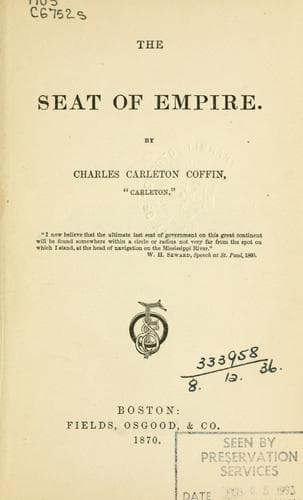
Minnesota -- Description and travel; Northwest, Canadian; Northwestern States; Red River of the North
A large amount is smelted at Lake Superior, where charcoal is used.
The forests in the vicinity of the mines are rapidly disappearing.
The wide-spreading sugar-maple, the hardy yellow birch, the feathery
hackmatack and evergreen hemlock are alike tumbled into the coal-pit
to supply fuel for the demands of commerce.
The charcoal consumed per ton in smelting costs about eleven cents
per bushel. For reducing a ton of the best ore about a hundred and
ten bushels are required; for a ton of the poorest about a hundred
and forty bushels, giving an average of $13 per ton. The cost of
mining is, as has already been stated, about $2 per ton. To this must
be added furnace-labor, interest on capital employed, insurance,
freight, commission, making the total cost about $35 a ton. As the iron
commands the highest price in the market, it will be seen that the iron
companies of Lake Superior are having an enormous income.
Some men who purchased land at government price are on the high road
to fortune. One man entered eighty acres of land, which now nets him
_twenty-four thousand dollars per annum_!
A railroad runs due west from Marquette, gaining by steep gradients the
general level of the ridge between Superior and Michigan. It is called
the Marquette and Ontonagon Railroad, and will soon form an important
link in the great iron highway across the continent. It is about twenty
miles from Marquette to the principal mines, which are also reached by
rail from Escanaba, on Green Bay, a distance of about seventy miles.
The ore is generally found in hills ranging from one to five hundred
feet above the level of the surrounding country. The elevations can
hardly be called mountains; they are knolls rather. They are iron warts
on Dame Nature's face. They are partially covered with earth,--the
slow-forming deposits of the alluvial period.
There are five varieties of ore. The most valuable is what is called
the specular hematite, which chemically is known as a pure _anhydrous
sesquioxide_. This ore yields about sixty-five per cent of pure iron.
It is sometimes found in conjunction with red quartz, and is then known
as mixed ore.
The next in importance is a soft hematite, resembling the ores of
Pennsylvania and Connecticut. It is quite porous, is more easily
reduced than any other variety, and yields about fifty per cent of pure
iron.
The magnetic ores are found farther west than those already described.
The Michigan, Washington, Champion, and Edwards mines are all magnetic.
Sometimes the magnetic and specular lie side by side, and it is a
puzzle to geologists and chemists alike to account for the difference
between them. As yet we are not able to understand by what subtle
alchemy the change has been produced.
Another variety is called the silicious hematite, which is more
difficult of reduction than the others. It varies in richness, and
there is an unlimited supply.
Public-domain text, read in full here on John Shaqi.
Reviews
Reviews
No reviews yet
Be the first to share your thoughts on this work.
Elsewhere in the archive
Join the Discussion
Join the discussion
Sign in to leave a comment or review.
Sign InorCreate an account