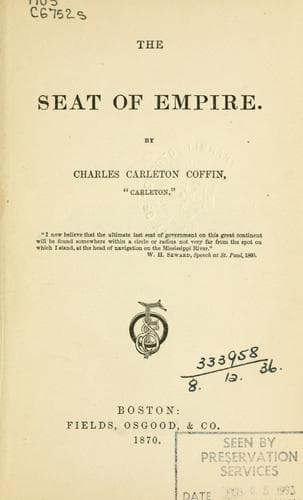
Minnesota -- Description and travel; Northwest, Canadian; Northwestern States; Red River of the North
If the past is any criterion for the future, its growth will be
unparalleled. Twenty years only have passed since it was organized as a
Territory. The population in 1850 was 5,330; in 1860 it was 172,022; in
1865, by the State census, 250,099. The census of 1870 will give more
than half a million. The tide of emigration is stronger at the present
time than it ever has been before, and the construction of the various
railroads, the liberal policy of the State, its munificent school-fund,
the richness of the lands, the abundance of pure, fresh water, the
delightful climate, the situation of the State in connection with
the transcontinental line of railway, altogether will give Minnesota
rapid advancement. Of the Northwest as of a pumpkin-vine during the
hot days and warm nights of midsummer, we may say that we can almost
see it grow! Look at the increase of wealth as represented by real and
personal estates:--
1850 $806,437
1855 10,424,157
1860 36,753,408
1865 45,127,318
1868 75,795,366
From the report of the Assistant Secretary of State made to the
Legislature in January, 1870, we have the following facts:--
Total tilled acres, 1,690,000
Value of real estate, $120,000,000
" " personal property, 65,000,000
" " live stock, 15,561,887
" " agricultural productions, 25,000,000
" " annual manufactures, 11,000,000
Amount of school-fund, 2,371,199
Not only is Minnesota to have a rapid development, but Dakota as
well. Civilization is advancing up the Missouri. Emigrants are moving
on through Yankton and taking possession of the rich lands of that
section, and the present year will see the more northern tide pouring
into the Red River Valley, which Professor Hind called the Paradise of
the Northwest.
"How much will it cost me to reach Minnesota, and get started on a
farm?"
The fare from Boston to St. Paul will be from $35 to $40. If you go
into the timbered regions, you will have lumber enough near at hand to
build your house, and it will take a great many sturdy strokes to get
rid of the oaks and pines. If you go upon the prairies, you will have
to obtain lumber from a distance. The prices at Minneapolis are all the
way from $12 to $45 per thousand, according to quality. Shingles cost
from $3.50 to $4.50.
Public-domain text, read in full here on John Shaqi.
Reviews
Reviews
No reviews yet
Be the first to share your thoughts on this work.
Elsewhere in the archive
Join the Discussion
Join the discussion
Sign in to leave a comment or review.
Sign InorCreate an account