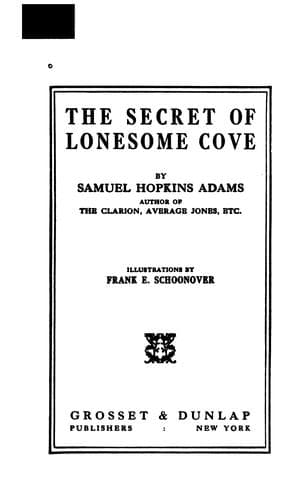
Detective and mystery stories; New England -- Fiction
Three hours later, wet and bedraggled, but with a fire at his heart, the
night-farer came to his home and roused Kent from slumber on the studio
couch.
“And where have you been?” demanded the scientist.
“She was in the house. I’ve seen her.”
“Exactly what I wished to prevent. I don’t think you’ve done yourself
any good.”
“Any good,” groaned his friend. “She left me believing that I am the
murderer of the unknown woman.”
“Indeed! You’ve done worse, even, than I had feared. Tell me.”
In brief outline, Sedgwick told of the moonlight interview. Kent gripped
at his ear lobe, and for a time sought silently to draw clarification of
ideas from it.
“Do you know,” he said at length, “I wouldn’t wonder if Blair really
thought you the murderer.”
“I would,” declared Sedgwick savagely. “He knows who murdered that
woman. It was his own son, whom he pretended to bury, for a blind.” And
the artist proceeded to outline eagerly his newly developed idea.
“That’s an interesting theory,” said Chester Kent slowly. “A very
interesting and ingenious theory. I’ll admit to you now that something
of the sort occurred to my mind early in the development of the mystery,
but I forsook it because of one fact that rather militates against its
probability.”
“What is that?”
“The fact,” replied Kent with a slow smile, “that Wilfrid Blair was dead
before his father ever learned of the tragedy of Lonesome Cove.”
CHAPTER XVII—CHANCE SITS IN
Suit case at his side, Chester Kent stood on the platform of the
Martindale Center station, waiting for the morning train to Boston.
Before him paced Sedgwick, with a face of storm.
“This is something I must do for myself,” the artist declared, with that
peculiar flatness of obstinacy which goes with an assertion repeatedly
made. “Not you, nor any other man, can do it for me.”
“Not you, nor any other man, should attempt it at all, now,” retorted
the scientist.
“That’s the view of the pedant,” cried Sedgwick. “What do you know of
love?”
“Nothing, except as a force obstructive to reason.”
“But, Chet, I _must_ see her again,” pleaded Sedgwick; “I must—”
“Exhibit that tact and delicacy which you displayed at your last
meeting,” broke in Kent curtly. “Asking a woman to marry you, on the day
of her husband’s burial!”
“It wasn’t her husband’s burial.”
“She supposed it was.”
Sedgwick checked his nervous pacing. “Do you think so? You believe she
wasn’t a party to that ghastly fraud?”
“Certainly not. She attended the funeral ceremony in good faith. In my
belief the real circumstances of Blair’s death are as unknown to her as
they are to—to you.”
“Assuming always that he is dead. Your confidence being so sound, it
must be based on something. How did he come to his death?”
“If I knew that, I shouldn’t be going to Boston to consult an
astrologer.”
“Have you still got astrology on the brain?”
“Hopelessly,” smiled Kent.
“Luck go with you. And I—”
“Yes: and you?” queried Kent, as the other hesitated.
Public-domain text, read in full here on John Shaqi.
Reviews
Reviews
No reviews yet
Be the first to share your thoughts on this work.
Elsewhere in the archive
Join the Discussion
Join the discussion
Sign in to leave a comment or review.
Sign InorCreate an account