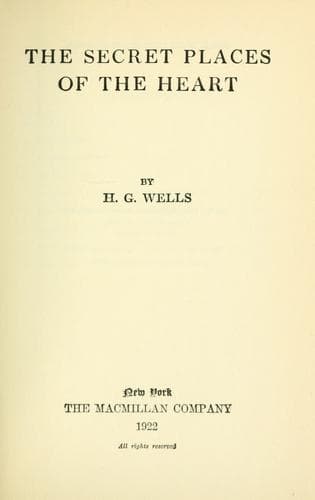
The Secret Places of the HeartWells, H. G. (Herbert George)
General
The Secret Places of the Heart
Wells, H. G. (Herbert George)
England -- Fiction; Man-woman relationships -- Fiction; Psychological fiction
Belinda, having distributed these, resumed her discourse of enthusiasm
for England. She asked a score of questions about Gloucester and
Chepstow, the Severn and the Romans and the Welsh, and did not wait for
the answers. She did not want answers; she talked to keep things going.
Her talk masked a certain constraint that came upon her companions after
the first morning’s greetings were over.
Sir Richmond as he had planned upstairs produced two Michelin maps.
“To-day,” he said, “we will run back to Bath--from which it will be easy
for you to train to Falmouth. We will go by Monmouth and then turn back
through the Forest of Dean, where you will get glimpses of primitive
coal mines still worked by two men and a boy with a windlass and a pail.
Perhaps we will go through Cirencester. I don’t know. Perhaps it is
better to go straight to Bath. In the very heart of Bath you will
find yourselves in just the same world you visited at Pompeii. Bath is
Pompeii overlaid by Jane Austen’s England.”
He paused for a moment. “We can wire to your agents from here before we
start and we can pick up their reply at Gloucester or Nailsworth or even
Bath itself. So that if your father is nearer than we suppose--But I
think to-morrow afternoon will be soon enough for Falmouth, anyhow.”
He stopped interrogatively.
Miss Grammont’s face was white. “That will do very well,” she said.
Section 4.
They started, but presently they came to high banks that showed such
masses of bluebells, ragged Robin, great stitchwort and the like that
Belinda was not to be restrained. She clamoured to stop the car and go
up the bank and pick her hands full, and so they drew up by the roadside
and Sir Richmond and Miss Grammont sat down near the car while Belinda
carried her enthusiastic onslaught on the flowers up the steep bank and
presently out of earshot.
The two lovers said unheeded things about the flowers to each other
and then fell silent. Then Miss Grammont turned her head and seemed
deliberately to measure her companion’s distance. Evidently she judged
her out of earshot.
“Well,” said Miss Grammont in her soft even voice. “We love one another.
Is that so still?”
“I could not love you more.”
“It wasn’t a dream?”
“No.”
“And to-morrow we part?”
He looked her in the eyes. “I have been thinking of that all night,” he
said at last.
“I too.”
“And you think--?”
“That we must part. Just as we arranged it when was it? Three days or
three ages ago? There is nothing else in the world to do except for us
to go our ways.... I love you. That means for a woman--It means that I
want to be with you. But that is impossible.... Don’t doubt whether I
love you because I say--impossible....”
Sir Richmond, faced with his own nocturnal decision, was now moved to
oppose it flatly. “Nothing that one can do is impossible.”
Public-domain text, read in full here on John Shaqi.
Reviews
Reviews
No reviews yet
Be the first to share your thoughts on this work.
Elsewhere in the archive
Join the Discussion
Join the discussion
Sign in to leave a comment or review.
Sign InorCreate an account