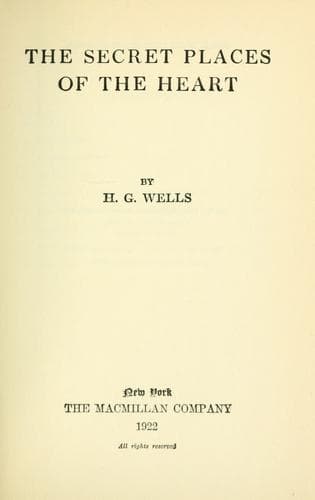
The Secret Places of the HeartWells, H. G. (Herbert George)
General
The Secret Places of the Heart
Wells, H. G. (Herbert George)
England -- Fiction; Man-woman relationships -- Fiction; Psychological fiction
Dr. Martineau went more than half way to meet Lady Hardy’s disposition
to treat him as a friend of the family. He had conceived a curious, half
maternal affection for Sir Richmond that had survived even the trying
incident of the Salisbury parting and revived very rapidly during the
last few weeks. This affection extended itself now to Lady Hardy. Hers
was a type that had always appealed to him. He could understand so well
the perplexed loyalty with which she was now setting herself to gather
together some preservative and reassuring evidences of this man who had
always been; as she put it, “never quite here.” It was as if she felt
that now it was at last possible to make a definite reality of him. He
could be fixed. And as he was fixed he would stay. Never more would he
be able to come in and with an almost expressionless glance wither the
interpretation she had imposed upon him. She was finding much comfort
in this task of reconstruction. She had gathered together in the
drawingroom every presentable portrait she had been able to find of him.
He had never, she said, sat to a painter, but there was an early pencil
sketch done within a couple of years of their marriage; there was a
number of photographs, several of which--she wanted the doctor’s advice
upon this point--she thought might be enlarged; there was a statuette
done by some woman artist who had once beguiled him into a sitting.
There was also a painting she had had worked up from a photograph and
some notes. She flitted among these memorials, going from one to the
other, undecided which to make the standard portrait. “That painting,
I think, is most like,” she said: “as he was before the war. But the war
and the Commission changed him,--worried him and aged him.... I grudged
him to that Commission. He let it worry him frightfully.”
“It meant very much to him,” said Dr. Martineau.
“It meant too much to him. But of course his ideas were splendid. You
know it is one of my hopes to get some sort of book done, explaining his
ideas. He would never write. He despised it--unreasonably. A real thing
done, he said, was better than a thousand books. Nobody read books, he
said, but women, parsons and idle people. But there must be books. And
I want one. Something a little more real than the ordinary official
biography.... I have thought of young Leighton, the secretary of the
Commission. He seems thoroughly intelligent and sympathetic and really
anxious to reconcile Richmond’s views with those of the big business men
on the Committee. He might do.... Or perhaps I might be able to persuade
two or three people to write down their impressions of him. A sort
of memorial volume.... But he was shy of friends. There was no man he
talked to very intimately about his ideas unless it was to you... I wish
I had the writer’s gift, doctor.”
Section 7
Public-domain text, read in full here on John Shaqi.
Reviews
Reviews
No reviews yet
Be the first to share your thoughts on this work.
Elsewhere in the archive
Join the Discussion
Join the discussion
Sign in to leave a comment or review.
Sign InorCreate an account